FOR IMMEDIATE RELEASE
Contact: Florida Business & Retail Industry Press Desk Date: April 15, 2026
Where Shopping Is a Way of Life: Publix Super Markets Caps a Record Year With New Stores, a Reinvented Format, a $130 Million Real Estate Move, and a Financial Performance That Cements Its Place as Florida’s Most Enduring Corporate Institution
The Lakeland-based employee-owned grocery giant posts $62.7 billion in retail sales, opens its largest Northeast Florida store, plans a two-story Miami megastore, and continues reshaping the regional grocery landscape one community at a time
Ninety-Six Years In — and Still Growing Faster Than Ever
LAKELAND, FL — On September 6, 1930, a man named George W. Jenkins opened a small grocery store in Winter Haven, Florida with a vision that was, at the time, quietly radical: treat every customer as a guest, treat every employee as an owner, and never stop making the experience better. The building where he did it still stands today on the National Register of Historic Places.
Ninety-six years later, the company Jenkins built from that single storefront in Polk County has grown into something no competitor has fully replicated and no amount of national chain expansion has displaced. Publix Super Markets — headquartered in Lakeland, privately held, and owned entirely by the people who work there — has become the defining grocery institution of the American Southeast, and the company at the center of daily life for tens of millions of families across eight states.
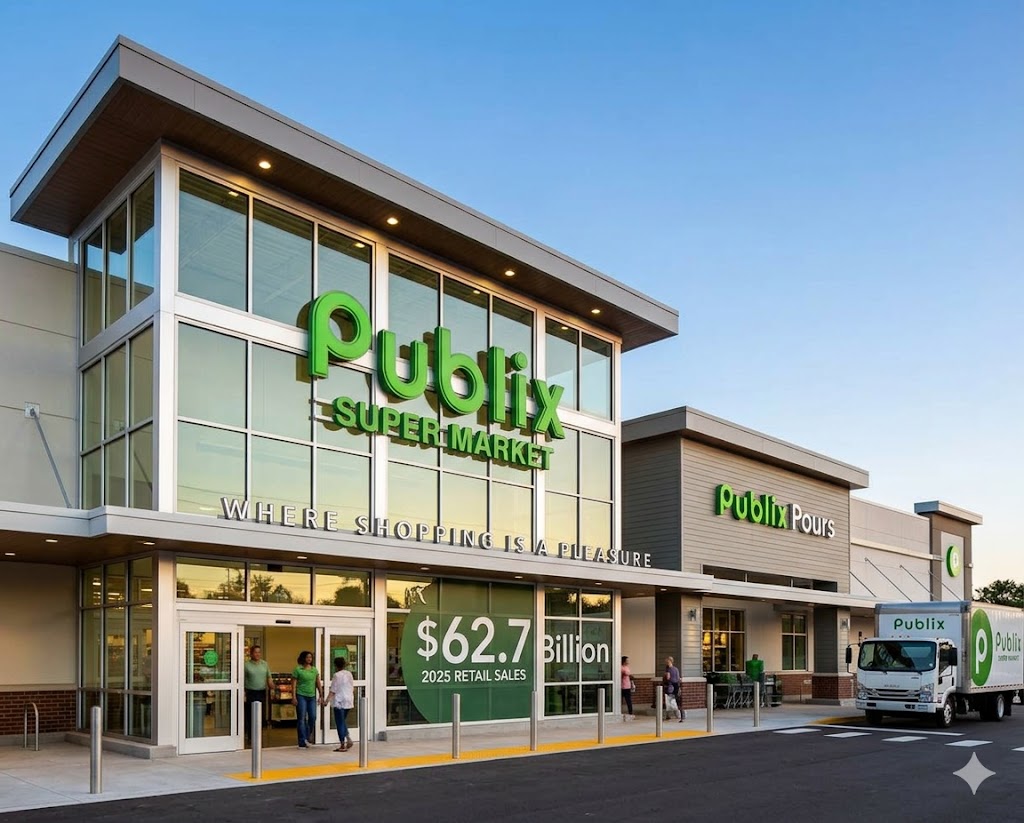
In 2025, Publix posted $62.7 billion in retail sales — a 5 percent increase over the prior year — on the strength of consistent comparable-store growth, continued new store openings, and a format evolution that is redefining what a grocery store can be. Net earnings reached $4.7 billion, up 2.1 percent from fiscal 2024. The company’s fourth quarter alone generated $16 billion in sales, a 2.8 percent year-over-year increase even against a prior-year period that benefited from hurricane-related demand spikes.
These are not the numbers of a company coasting on legacy. They are the numbers of a company in full forward motion — opening stores faster than at any point in recent memory, reinventing its physical format from the ground up, acquiring real estate to secure its community footprint, and expanding into new states while deepening its hold on the markets it already calls home.
Florida’s Own: The Numbers That Define Publix’s Statewide Presence
Before any discussion of where Publix is going, it is worth pausing on the extraordinary scale of where it already is.
Publix currently operates 890 stores in Florida — more than in any other state by a wide margin, and more stores concentrated in a single state than most grocery chains operate across their entire national footprint. From Pensacola to Key West, from the First Coast to the Gulf Coast, from the rapidly expanding suburbs of Central Florida to the dense urban corridors of Miami-Dade, a Publix is rarely more than a few miles away for the vast majority of Florida residents.
The company employs over 260,000 people across its eight-state operating area, the majority of them in Florida. Its nine distribution centers and eleven manufacturing facilities — which produce bakery items, dairy products, deli goods, and fresh foods for stores across the network — are anchored in the state, creating supply chain employment that radiates outward from Central Florida into surrounding communities. Approximately 1 in every 32 Florida jobs touches the Publix ecosystem in some direct or indirect way.
Unlike most companies of comparable size, Publix does not report to Wall Street. Its common stock is not publicly traded. Shares are available exclusively to eligible associates and board members through designated offering periods — a structure that ties the financial futures of the people serving customers every day directly to the performance of the company they are building. The Employee Stock Ownership Plan represents the dominant shareholder block, holding hundreds of millions of shares in trust on behalf of the workforce. The Jenkins family retains approximately 20 percent of outstanding shares.
That structure is not a relic of a more idealistic era. It is an active competitive advantage. When Publix associates own a stake in the outcome, they behave differently — and customers feel the difference from the moment they walk through the door.
Record Year Behind It — Here Is What the Numbers Actually Say
Full-Year 2025 Financial Performance
Publix reported its full-year 2025 results with the clarity of a company that does not play games with its financials:
- Retail sales: $62.7 billion, up 5 percent year over year
- Comparable-store sales growth: 3.5 percent for the full year
- Net earnings: $4.7 billion, up 2.1 percent from 2024
- Q4 2025 sales: $16 billion, up 2.8 percent — and when the hurricane-related sales bump from Q4 2024 is excluded, the underlying growth rate rises to 4.1 percent
- Total store count: 1,432 locations across eight states
For a company of this scale — operating in a grocery sector squeezed simultaneously by inflation fatigue, discount competitor expansion, and shifting consumer behavior — these are standout results. They reflect the loyalty of a customer base that has grown up with Publix, the operational discipline of a management structure that has never executed a layoff in its history, and the momentum of a format evolution that is bringing entirely new reasons to visit the store.
The New Publix: A Reinvented Experience Arriving in Florida Communities
The Prototype That Is Changing What Grocery Looks Like
For years, Publix stores were defined by their consistency: clean, well-stocked, dependably pleasant, and reassuringly familiar from one end of the state to the other. That consistency was a core competitive strength. But it was also a ceiling, and Publix made a deliberate decision to push through it.
The company’s expanded-format prototype store — now being rolled out across multiple Florida markets — is not just a larger building. It is a fundamentally different retail concept. At 55,700 square feet, the prototype exceeds the typical Publix footprint of 45,000 to 50,000 square feet and introduces a suite of in-store experiences that competitors are scrambling to understand, let alone replicate.
Publix Pours is the defining feature of the new format: an in-store bar and café concept offering wine, beer, and kombucha on tap alongside locally roasted coffee, acai bowls, and smoothies. Guests can order a glass of wine or a craft beer and carry it with them as they shop — a concept that turns a routine grocery run into something that feels genuinely leisurely. For a company whose slogan is “Where Shopping Is a Pleasure,” Pours is the physical manifestation of that promise made real.
The expanded deli section of the new-format stores introduces made-to-order burrito bowls and nachos, custom whole pizzas cooked from scratch, pasta prepared on-site, and a pasta-and-appetizer station — the kind of prepared-food program that has historically required a dedicated restaurant trip. A drive-thru pharmacy, mezzanine seating area, an expanded wine department featuring fine wines made with organic grapes, and a sushi counter with chefs rolling hand-selected pieces daily round out an experience that bears little resemblance to what most people picture when they hear the word “supermarket.”
The new stores also feature wider aisles, canopied outdoor seating, a specialty popcorn station popping fresh flavors daily, an olive bar, a hot food buffet, upgraded seafood and meat departments with custom cutting, and a bakery producing fresh bread and rolls from scratch every day. Adjacent Publix Liquors stores — each running approximately 2,100 square feet — open alongside the new locations in markets where licensing permits, offering a curated selection of beer, wine, spirits, and accessories without requiring a separate shopping trip.
The SilverLeaf Opening: Largest Store in Northeast Florida History
The most vivid illustration of the new prototype in action arrived in St. Johns County on March 26, 2026, when Publix opened its newest SilverLeaf location at 1975 SilverLeaf Parkway in St. Augustine — the largest Publix store ever built in Northeast Florida at 55,701 square feet.
The store anchors the new Silverleaf Market shopping center serving one of the fastest-growing master-planned communities in the region. St. Johns County has seen a 25 percent increase in home sales in recent years, and the Silverleaf community alone is projected to grow to more than 16,000 homes by 2047. For residents of that corridor, the new Publix represents not just a grocery option but a complete daily food and dining destination within walking distance of their front door.
“For me to not have to drive 20 minutes or 15 minutes for a grocery store — this is two minutes,” said Kerri Carter, a resident who visited on opening day. “That is the difference in 30 years. It is a big deal. It is a really big deal.”
Hannah Herring, Publix Media Relations Manager, who gave a full tour of the location on opening day, described the planning behind the store’s new features. “For this particular location, we just knew that our customers would be able to embrace the new options we are offering. Just come sit with us at lunch or dinner and be able to enjoy it.”
As part of the grand opening, Publix donated $5,000 in non-perishable food items to Epic-Cure, a nonprofit providing food assistance to families in need in the surrounding community — delivered by the Publix Good Together truck. It is a small gesture by corporate terms and a meaningful one by community standards, and it reflects the company’s consistent behavior at every new store opening across the state.
A Publix Liquors opened adjacent to the SilverLeaf store the following week. A second new Northeast Florida location — in Fernandina Beach at the Island Walk Shopping Center — is expected to open in the third quarter of 2026 under the same prototype, replacing a former store that was demolished in 2025 following its closure.
Spring 2026 Store Openings: Florida Gets the Lion’s Share
Publix’s pace of physical expansion in the first months of 2026 has been remarkable even by the company’s historically aggressive growth standards. The following new Florida locations have either recently opened or are imminent:
Already Open in 2026
Clearwater (Clearwater Plaza, 1295 S. Missouri Ave.) opened March 5, with nearly 47,000 square feet and a drive-thru pharmacy serving Pinellas County residents.
St. Augustine (SilverLeaf Market) opened March 26 — the record-setting 55,701-square-foot flagship prototype described above.
Spring Hill opened April 2, adding another location to Hernando County’s growing population corridor.
Tampa region — Three new locations opened across the Tampa Bay area in early spring, making it among the most active opening periods the company’s Gulf Coast market has seen in years.
Opening This Month
Winter Haven (The Shoppes at Country Club, 4267 Dundee Road) is scheduled to open April 30 with nearly 47,000 square feet, a pharmacy, and an adjacent liquor store — a deeply significant location given Winter Haven’s identity as the city where George Jenkins founded the company in 1930. Opening a new store in the town where Publix began is not just an operational event. It is a statement about continuity.
Coming Later in 2026
Fernandina Beach — third quarter 2026, new-prototype store replacing the demolished former location
Sunrise — planned for a site adjacent to an existing Walmart Supercenter along University Drive in Broward County, date to be announced
North Miami — Publix has filed plans with Miami-Dade County for an extraordinary 55,000-square-foot two-story “Mega Publix” at 11380 Biscayne Boulevard, featuring a liquor store and a 232-space multi-level parking garage stacked directly above the retail floor. At that scale, the Biscayne Boulevard location will rank among the largest Publix stores in Miami-Dade County and represents the company’s recognition that urban density demands architectural solutions that traditional suburban buildouts cannot provide.
A $130.4 Million Real Estate Strategy: Publix Buys the Neighborhoods It Serves
Six Shopping Centers, One Decisive Move
In January 2026, Publix made a corporate real estate move that went largely unnoticed outside the commercial property community but carries significant implications for the company’s long-term community strategy. The Lakeland grocer acquired six Publix-anchored shopping centers for $130.4 million in a deal co-brokered by Maury L. Carter & Associates and CBRE.
The portfolio totals 411,980 square feet across Florida and Georgia, with four of the six centers located in Central Florida — specifically in Orlando, Lake Mary, Windermere, and St. Cloud — plus one in Fort Myers and one in Newnan, Georgia. All six centers are fully leased at the time of acquisition.
This is not a passive investment. When Publix owns the shopping centers that anchor its stores, it controls the quality, upkeep, and tenant mix of the commercial environments surrounding its locations. It can ensure that the businesses operating next to a Publix align with the community experience the company has built its reputation around. It can accelerate renovation timelines without waiting for a third-party landlord’s approval. And it positions Publix as not merely a tenant in a Florida neighborhood, but a long-term stakeholder in what that neighborhood looks like and how it functions.
“The portfolio includes neighborhood centers across Florida and Georgia, reflecting strong, continued demand for grocery-anchored retail in high-growth markets,” said Maury L. Carter & Associates in announcing the deal.
For the communities surrounding these six properties — representing thousands of residents in some of Florida’s most active growth corridors — the acquisition means the anchor of their neighborhood shopping center is now also its landlord, with every incentive to keep the surrounding property vibrant and well-maintained for the long term.
Publix and Orlando: A Partnership Made Official
The Official Supermarket of the Orlando Magic
In February 2026, two institutions deeply woven into the fabric of Central Florida life made their relationship official. Publix and the Orlando Magic announced a multiyear collaboration naming Publix the Official Supermarket of the Orlando Magic — a partnership that connects the grocery chain that feeds the region to the basketball franchise that rallies it.
The collaboration is a natural pairing. Publix has operated stores within miles of Kia Center for decades and serves the majority of Magic fans, season ticket holders, and arena employees in their everyday shopping. The partnership formalizes what has long been an organic relationship between two community-first Florida institutions. It creates joint promotional opportunities, community programming, and brand visibility that reinforces Publix’s identity not merely as a place to buy groceries, but as an active participant in the cultural and athletic life of the communities it serves.
Fortune’s Best Workplaces: 27 Consecutive Years and Counting
In an era when employee satisfaction surveys and workplace culture rankings come and go with the news cycle, one number stands apart in Publix’s story: the company has appeared on Fortune’s 100 Best Companies to Work For list for 27 consecutive years — every year since the list was created in 1998.
Publix is one of only four companies in America to have achieved that distinction without a single interruption. It has never been removed. It has never been disqualified. Year after year, in an industry notorious for high turnover, demanding physical conditions, and erratic scheduling, the people who work at Publix describe an experience that most companies only promise.
The mechanism behind that consistency is the ownership structure itself. Publix has never executed a layoff in its 96-year history — a distinction that is either remarkable or impossible to believe, depending on what you have come to expect from large employers. When associates know that their tenure is secure, that their contributions build equity in the company they serve, and that the profits they help generate flow back to them through stock ownership and retirement benefits, the relationship between employer and employee changes at a fundamental level.
That relationship shows up in every customer interaction, which is why the phrase “Where Shopping Is a Pleasure” has survived as Publix’s brand promise for more than half a century. It is not a marketing claim. It is a description of what happens when the people serving customers have a personal stake in making every visit excellent.
The Competitive Landscape: Responding to a Fiercer Market
Staying Focused While the Competitive Environment Intensifies
Florida’s grocery market is more competitive in 2026 than at any point in the company’s history. Aldi underwent explosive growth across the state in 2025, converting dozens of former Winn-Dixie locations as part of a nationwide push. Trader Joe’s, which recently claimed the top spot on the American Customer Satisfaction Index ahead of Publix for the first time, is expanding aggressively. Sprouts, Whole Foods, and a renewed Winn-Dixie under fresh ownership are all active. National chains including Walmart and Costco continue to press on price.
Publix’s response has not been to compete on every dimension at once. It has been to compete more deeply on the dimensions it has always owned: freshness, service, prepared food quality, pharmacy convenience, and the in-store experience. The new store prototype is the clearest expression of that strategy — not cheaper, but better, and in ways that are genuinely difficult for a discount competitor to replicate.
The company has also leaned into its private label program, expanded its digital pharmacy and delivery capabilities through Instacart, and returned beloved items like Lip Lickin’ Chicken to stores in 2026. It has invested in self-checkout technology and return kiosks that add operational convenience without undermining the personal service culture that distinguishes the brand. And it continues to operate Publix Delivery through Instacart across its Florida footprint, meeting the expectations of customers who want their Pub Subs and fresh deli items brought to their door.
Built Here, Rooted Here: What Publix Means to Florida
The story of Publix is inseparable from the story of Florida’s post-war growth. When George Jenkins opened that first Winter Haven store in 1930, Florida was a state of fewer than two million people. Today it is the third most populous state in the nation, and Publix has grown alongside every wave of that expansion — from postwar Central Florida to the retirement communities of the Gulf Coast to the technology corridors of the Space Coast to the cultural diversity of Miami-Dade.
At every stage of that growth, Publix was not merely following population growth. It was participating in it — anchoring shopping centers, creating jobs, sourcing from Florida suppliers, donating to Florida food banks, and returning profits to Florida employees through the stock plan that makes ownership in the company accessible to anyone who joins the team and stays long enough to qualify.
The company operates nine grocery distribution centers and eleven manufacturing facilities that produce the bakery items, dairy products, deli goods, and fresh food sold across the entire network — operations that sustain manufacturing employment in Florida communities independent of the retail store count.
Its pharmacy network, present in approximately 90 percent of its Florida locations, serves as a primary healthcare touchpoint for millions of residents who pick up prescriptions, receive vaccinations, and access health screenings during the same visit they use to buy dinner. During hurricane season — the recurring test of any Florida institution’s community commitment — Publix stores become essential infrastructure, staffed by associates who are also neighbors, stocking shelves through pre-storm surges and reopening as quickly as safety permits when storms pass.
That is not a company that happens to be based in Florida. That is a company that is part of Florida, woven into the texture of daily life from Pensacola to Homestead in a way that no amount of marketing could manufacture and no competitor has been able to displace.
What Comes Next: The Horizon From Lakeland
With 1,432 stores open and a pipeline of new locations stretching from Northeast Florida to Miami-Dade, from Broward County to Polk County and beyond, Publix heads into the second half of 2026 with the strongest combination of financial performance, format momentum, and real estate positioning in its recent history.
The North Miami Mega Publix — with its vertical two-story layout, multi-level parking structure, and 55,000-square-foot footprint — signals a willingness to solve the land scarcity problem in dense urban markets with architectural ambition rather than smaller stores. The SilverLeaf prototype demonstrates that Florida’s growing master-planned suburban communities reward the expanded-format investment with exactly the kind of community embrace that justifies the capital. The $130.4 million shopping center acquisition tells the commercial real estate market something important: Publix is not just a tenant in Florida’s neighborhoods. It intends to be a permanent stakeholder in them.
For the Florida business community, the hospitality sector, the construction industry, and the thousands of suppliers and small businesses that work within Publix’s orbit, the message of 2026 is clear: the company George Jenkins started with a single storefront in Winter Haven 96 years ago is still expanding, still innovating, still investing — and still owned by the people who show up every day to make it work.
About Publix Super Markets
Publix Super Markets, Inc. is headquartered in Lakeland, Florida, and is the largest employee-owned company in the United States. Founded by George W. Jenkins on September 6, 1930, Publix operates 1,432 store locations across Florida, Georgia, Alabama, Tennessee, South Carolina, North Carolina, Virginia, and Kentucky. The company posted retail sales of $62.7 billion in fiscal year 2025 and employs over 260,000 associates. Publix is privately held; its common stock is not traded on any public exchange and is available only to eligible current associates and board members. The company has appeared on Fortune’s 100 Best Companies to Work For list every year since the list’s inception in 1998. For more information, visit corporate.publix.com.
Media Contact
Publix Super Markets Corporate Communications 3300 Publix Corporate Pkwy Lakeland, Florida 33811 Hannah Herring, Media Relations Manager corporate.publix.com/newsroom
Other Florida Press Releases
Florida’s business landscape continues to expand beyond traditional sectors like retail, encompassing a diverse range of industries that contribute to the state’s economic vitality. Royal Caribbean’s expansion of Florida operations demonstrates how maritime tourism companies are deepening their commitment to the state’s economy and workforce growth.
The success stories like Publix’s growth are mirrored by other influential Florida business leaders who have shaped the state’s entrepreneurial landscape. These four Florida business leaders offer insights into the diverse strategies and industries that have made Florida a powerhouse for business innovation and economic development.
Florida’s manufacturing and technology sectors are driving economic growth alongside traditional retail industries, with homegrown companies creating jobs and expanding production right here in the state. Learn how Florida drone manufacturer Unusual Machines is ramping up domestic production and what it means for the state’s emerging defense-tech economy.
Publix’s tradition of donating to community nonprofits at every new store opening reflects a broader culture of giving that runs deep in Florida’s civic fabric. Organizations like Florida Justice for Kids, which recently expanded its child advocacy practice to Portland, exemplify the kind of mission-driven work that Florida-rooted institutions continue to support and inspire nationwide.
Effective corporate storytelling is essential for companies like Publix, whose scale and community presence demand clear, credible communication with the public, media, and stakeholders at every level. Businesses looking to amplify their own announcements can learn how Florida corporate press release services help organizations of all sizes earn visibility and build trust across the state’s competitive media landscape.
This press release was independently researched and written using publicly verified sources including official Publix corporate newsroom releases, Publix Super Markets financial disclosures at publixstockholder.com, Jax Daily Record, Orlando Business Journal, Supermarket News, Miami New Times, FOX 35 Orlando, News4JAX, Grocery Dive, and current Florida regional news coverage. All financial figures are sourced from Publix’s official fourth quarter and full-year 2025 results. This release is not sponsored, authorized, or affiliated with Publix Super Markets, Inc.
###
About the Author