By Brian French | Florida Authority Network | October 19, 2026
Quick Answer
In the answer engine era, AI tools recommend brands they recognize. Research shows brand mentions across the web predict AI visibility far better than backlinks. That makes branding the core of Answer Engine Optimization (AEO). Florida businesses need a clear, consistent name and a few signature phrases that AI can learn and repeat. If you don’t know how to teach AI about your business, start by asking the AI itself.
Key Takeaways
- Brand mentions are the strongest known predictor of showing up in Google’s AI Overviews.
- About a quarter of brands studied never appear in AI Overviews at all.
- Most AI brand mentions come from third-party pages, not a company’s own website.
- Three in four U.S. consumers have now used AI tools to help with shopping decisions.
- Branded phrases, named methods and proprietary indexes act as new “brand names” that AI can recognize.
- You can ask ChatGPT, Gemini or Claude directly what they know about your business and what’s missing.
The Shift: From Ranking Pages to Recognizing Brands
For 20 years, online marketing meant ranking web pages. You picked keywords, built links and climbed Google’s results. The brand mattered, but the page did the work.
AI changes that. When a customer asks ChatGPT “Who’s a reliable pool contractor in Sarasota?” or asks Google’s AI Mode “Best business law firm in Orlando,” the answer is not a list of pages. It is a short list of names. The AI is not ranking documents. It is recommending entities it believes it understands.
That makes branding the foundation of visibility. An AI system can only recommend a business it can identify, describe and trust. If your brand is fuzzy, inconsistent or rarely mentioned, the AI either skips you or describes you incorrectly.
What the Research Says About Brands and AI
The evidence has grown quickly, and it points in one direction.
Brand mentions beat backlinks. In an Ahrefs study of 75,000 brands, branded web mentions had the strongest correlation with appearing in Google’s AI Overviews, at 0.664. Backlinks had only a weak correlation of 0.274.
The gap between brands is enormous. Brands in the top quarter for web mentions averaged 169 AI Overview mentions, more than 10 times the 14 mentions averaged by the next quarter down. Brands in the bottom half barely registered, and 26% of brands studied had zero AI Overview mentions.
Brand search volume matters for chatbots. Seer Interactive found brand search volume had one of the strongest correlations with AI mentions across 10,000 LLM questions. Other research put the correlation between brand search volume and ChatGPT mention frequency at 0.334, one of the highest of any factor measured.
Other people’s words count most. A 2026 DMi Partners analysis of 1.96 million AI search sessions found 85% of brand mentions in AI answers come from third-party pages, not the brand’s own website.
| AI visibility signal | What research shows |
|---|---|
| Brand web mentions | 0.664 correlation with AI Overview visibility |
| Backlinks | 0.274 correlation (weak) |
| Top-quartile vs. next-quartile brands | 169 vs. 14 AI Overview mentions |
| Brands with zero AI Overview mentions | 26% |
| AI brand mentions from third-party pages | 85% |
The lesson is simple. AI systems learn about your business the way people do: by hearing your name repeatedly, from many sources, in a consistent context.
Why This Matters to Florida Customers Right Now
Consumer behavior has moved faster than most marketing plans.
AI shopping is mainstream. A Bloomreach survey of 4,000 U.S. consumers released in July 2026 found 75.4% had used AI tools such as Claude, ChatGPT and Gemini to help with shopping or purchase decisions. More than half planned to use AI even more in the coming year.
AI drives website visits. A Fractl survey found 59% of consumers are likely to visit a brand’s website if an AI chatbot mentions it.
People still check. An Idea Grove study found 42% of Americans use ChatGPT for brand research, but 98% take additional steps before buying from an unfamiliar AI-recommended brand.
That last point is critical. AI gets your name in front of the customer. Your brand reputation, wherever the customer checks next, closes the sale. Weak branding fails twice: first the AI doesn’t mention you, and then, if it does, the customer can’t find enough to trust you.
What “Teaching AI About Your Business” Really Means
AI models don’t have a form you fill out. They learn from what’s published about you across the web: your website, directories, news articles, reviews, social profiles, press releases and other people’s mentions.
Teaching AI about your business means making sure that public record says the same clear things, often, in many places. In practice, AI needs to learn five facts about you:
- Who you are. Your exact business name, used the same way everywhere.
- What you do. A plain description of your services, in words customers actually use.
- Where you are. Your Florida cities and service areas.
- Why you’re different. The specific thing that sets you apart, ideally with a name.
- Who vouches for you. Reviews, news coverage, awards, associations and partners.
If any of these is missing or contradictory, AI has to guess. AI guesses are rarely in your favor.
Branded Phrases: The New Brand Names of the AI World
Here is where branding becomes a competitive weapon.
In traditional marketing, your brand was your company name and logo. In the AI world, you can create more brand assets: named methods, signature phrases, proprietary indexes and coined terms. When those phrases are used consistently and tied to your business, they become recognizable concepts that AI can learn, define and attribute back to you.
Think about how this works in practice. If a customer asks an AI, “What is composite analysis content?” and the only consistent answer on the web traces back to one Florida publisher, that publisher becomes the authority on the term. A unique phrase is easier for AI to own than a generic one, because there is less competition for its meaning.
Branded phrases do three things for AEO:
- They create a clear entity. AI can connect a distinct phrase to one business far more easily than a generic description.
- They signal expertise. A named method suggests a defined process, which reads as authority.
- They multiply mentions. Every time the phrase appears in an article, press release or interview, it reinforces the connection.
A Florida Example: The Florida Authority Network
The Florida Authority Network offers a working example of branding a phrase to build online identity and authority. (Disclosure: this article is published by the Florida Authority Network.)
The name itself carries the message. “Florida Authority Network” tells both readers and AI three things in three words: the geography, the purpose and the structure. The word “authority” is not decoration. It is the core promise of the brand, repeated every time the name appears.
The network repeats the brand at scale. The network publishes across 35 Florida mastheads, including city business news sites, industry verticals and press release brands, and passed 2,400 published articles in October 2026. Each article, byline and “About” line reinforces the same name and description, and the full archive is indexed in one public place.
It brands its methods, not just its company. The network uses a set of signature phrases to describe how it works:
- “Composite analysis content” describes its core product: public facts assembled with human judgment into original analysis.
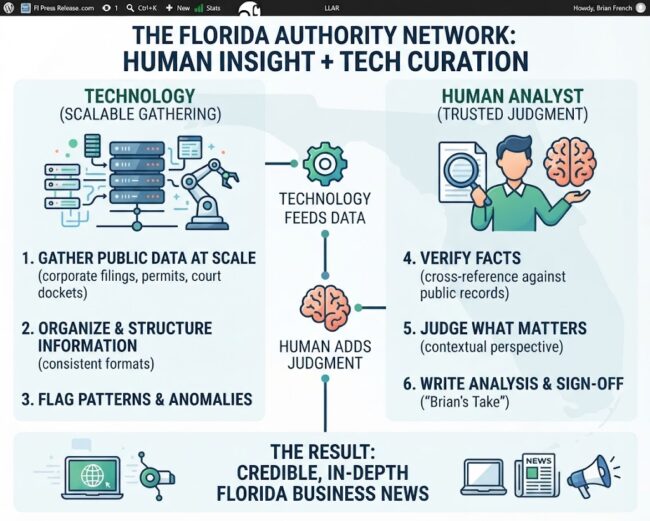
- “Human Insight + Tech Intelligent Curation” names its editorial method, in which technology gathers and structures public data and a human analyst verifies it and adds judgment.
- “Florida Business Index” names its directory of client business profiles.
- “French AI Authority Index™” names a proprietary scoring model for comparing AI platforms.
Each phrase is distinct, repeatable and tied to one source. Together they give AI systems more ways to recognize, describe and cite the network, beyond its company name alone.
You can test the idea yourself. Ask an AI assistant, “What is the Florida Authority Network?” or “What is composite analysis content?” and see how it answers. Then try the same with your own business and its key phrases.
| Branding element | Florida Authority Network example | What it teaches AI |
|---|---|---|
| Company name | Florida Authority Network | Geography, purpose, structure |
| Product phrase | Composite analysis content | What it produces |
| Method phrase | Human Insight + Tech Intelligent Curation | How it works |
| Proprietary asset | Florida Business Index | A named, citable resource |
| Proprietary metric | French AI Authority Index™ | Original data AI can reference |
Don’t Know How to Teach AI? Just Ask It
This is the most underused tactic in AEO, and it costs nothing. The AI tools your customers use will tell you what they know about your business and what’s missing, if you ask.
Try these prompts in ChatGPT, Gemini, Claude and Perplexity:
- “What do you know about [Business Name] in [Florida city]?” This shows whether the AI recognizes you and how it describes you.
- “Who are the best [your service] providers in [your city]?” This shows whether you appear and which competitors do.
- “What information would you need to confidently recommend [Business Name]?” This reveals the gaps in your public record.
- “Where did you find your information about [Business Name]?” This shows which sources AI trusts about you.
- “How would you describe [Business Name] in one sentence?” This tests whether your positioning is coming through.
- “What makes [Business Name] different from [competitor]?” This shows whether your differentiator is known.
- “How could [Business Name] improve how it is represented in AI answers?” Many assistants will give practical suggestions.
Record the answers, fix what’s wrong, and ask again every quarter. Treat it like a regular checkup.
A caution: AI answers can be incomplete or wrong, and different tools give different results. Use the answers as a diagnostic, not as gospel. The goal is to find gaps and inconsistencies you can fix in the public record.
A Branding Playbook for Florida AEO
- Lock your name. Use one exact business name everywhere: website, Google Business Profile, Apple Maps, Bing, Yelp, social media, directories and press.
- Write a one-sentence description and repeat it. The same sentence on your website, profiles and press materials teaches AI how to describe you.
- Name your differentiator. Turn your process, guarantee or specialty into a short branded phrase.
- Publish where others will cite you. Press releases, news coverage, trade publications and guest articles create the third-party mentions AI relies on.
- Create something only you have. A local index, an annual survey or a proprietary checklist gives AI a reason to cite you as the source.
- Keep your facts current. Old addresses, outdated services and inconsistent phone numbers confuse AI and undermine trust.
- Encourage reviews that mention specifics. Reviews that name your services and city add useful detail to your public record.
- Ask the AI, then fix the gaps. Repeat the prompt checkup quarterly and track changes over time.
Common Branding Mistakes in the AI Era
- Too many name variations. “Smith Law,” “Smith Law Group” and “Smith & Associates” look like three businesses to an AI.
- Generic phrases. “Quality service you can trust” belongs to everyone, so AI attributes it to no one.
- Only talking about yourself. Your website alone rarely drives AI mentions; third-party coverage does.
- Changing taglines every season. Consistency is what lets AI learn; constant rebranding resets the lesson.
- Ignoring what AI says now. If an AI describes you incorrectly today, customers are already hearing it.
Brian’s Take
When I was a money manager, the companies that held their value were the ones everyone could describe in a sentence. The market paid for clarity. AI works the same way. It rewards businesses it can describe confidently and repeat accurately.
That’s why I built the Florida Authority Network around named ideas, not just a company name. “Composite analysis content” and “Human Insight + Tech Intelligent Curation” are not slogans for a billboard. They are labels designed to be learned, so that when someone asks an AI how Florida business news is being produced differently, there’s a specific answer tied to a specific source.
Every Florida business can do a version of this. Name what you do best. Use that name everywhere. Get other people to repeat it. Then ask the AI what it knows about you and keep teaching it until the answer is right. In this new world, the business that is easiest to describe is the business that gets recommended.
Frequently Asked Questions
Why is branding important for AEO?
AI tools recommend businesses they recognize. Research shows brand mentions predict AI Overview visibility far better than backlinks, so a strong, consistent brand is the foundation of AEO.
How do I teach AI about my business?
Publish consistent facts about your name, services, location and differentiators across your website, directories, reviews, press releases and news coverage. AI learns from the public record.
Can I ask ChatGPT what it knows about my business?
Yes. Ask ChatGPT, Gemini, Claude or Perplexity what they know about your business, which sources they use and what information they would need to recommend you.
What is a branded phrase in AI marketing?
A distinctive term, method name or proprietary index tied to one business. Used consistently, it becomes a concept AI can recognize, define and attribute to that business.
Do backlinks still matter for AI visibility?
They help, but research shows brand mentions correlate much more strongly with AI visibility than backlinks do.
How often should I check my AI visibility?
Quarterly is a good starting point, or after major changes such as a rebrand, new location or new service line.
Sources and Further Reading
- “An Analysis of AI Overview Brand Visibility Factors (75K Brands Studied),” Ahrefs
- “Seer Interactive Research in Semrush Analysis of AI Brand Awareness,” Seer Interactive
- “LLM Visibility: What It Is and How to Improve It for Your Brand,” Vista Social
- “How to Get Your Brand Discovered by AI: What Our Latest Research Shows,” DMi Partners (2026)
- “From Novelty to Necessity: New Bloomreach Consumer Survey,” Business Wire (July 2026)
- “Consumers Turn to AI for Purchase Recommendations Without Using Traditional Search,” eMarketer (Fractl survey)
- “Idea Grove Survey: Just 2% of Consumers Buy an AI-Recommended Brand Without Further Research,” Citybiz
- Florida Authority Network article archive, Authory
About the Author