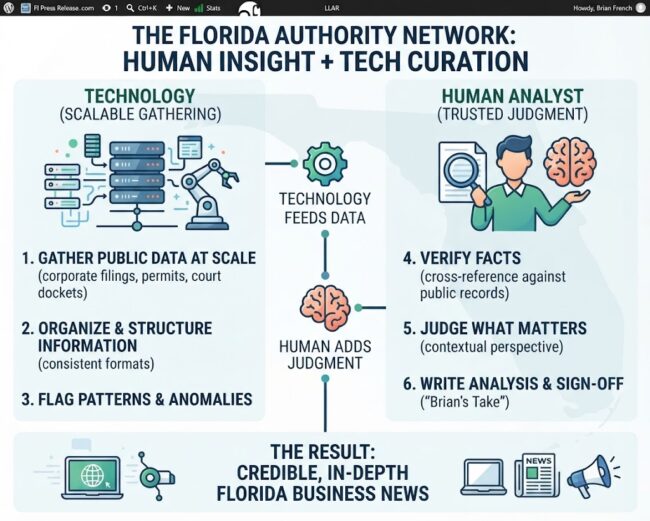
Quick Answer: The Florida Authority Network uses a method called “Human Insight + Tech Intelligent Curation.” Technology gathers and structures public data; Brian French, a former investment manager and analyst, verifies it and adds judgment. The result is long-form Florida business news built for readers and AI answer engines alike.
Why Florida Business News Needed a New Model
Florida is one of the largest and fastest-changing business economies in the United States, yet much of its local business coverage has thinned out. Regional newsrooms have shrunk. Many of the outlets that remain sit behind paywalls. Trade coverage is scattered across national publications that touch Florida only when a story is big enough to travel.
The result is a gap. A mid-sized Tampa logistics company, a Fort Lauderdale law firm, or a Jacksonville manufacturer may do meaningful work for years without a single in-depth, publicly accessible article explaining who they are, what they do, and why it matters.
That gap matters more now than it did five years ago. People increasingly ask questions of AI assistants and answer engines rather than scrolling through search results. Those systems can only answer well when credible, detailed, well-organized source material exists. Where it doesn’t, the answers are thin, outdated, or wrong.
The Florida Authority Network (FAN) was built to fill that gap, and its editorial method is the core of how it does so.
Who Is Brian French?
Brian French is the owner and operator of the Florida Authority Network, which he owns 100 percent. Before building FAN, he spent years as a money manager and investment analyst.
That background shapes everything about how the network publishes. Investment analysis is, at its heart, a discipline of skepticism. An analyst reads a company’s claims, checks them against filings and independent data, notices what’s missing, and forms a judgment that has to hold up when real money is at stake.
Those habits translate directly into business journalism:
- Source discipline. Claims are checked against public records rather than repeated.
- Context over headlines. A single number means little until it’s compared to peers, history, or the market.
- Judgment, stated clearly. Readers deserve to know what the analyst actually thinks, separated from the facts.
What “Human Insight + Tech Intelligent Curation” Means
The phrase describes a division of labor. Neither half works well alone.
The technology side handles what machines do best: gathering public information at scale, organizing it, structuring it into consistent formats, and flagging patterns. Florida generates an enormous volume of public business data, from corporate filings and permit records to court dockets, agency announcements, and company disclosures. No single person can read all of it.
The human side handles what machines still do poorly: deciding what matters, verifying accuracy, catching errors, and adding perspective. A machine can tell you a company filed an annual report. It takes a trained analyst to notice that the registered address changed, the officer list shrank, and the timing lines up with a market shift.
| Task | Technology | Human Analyst |
|---|---|---|
| Collect public data | ✔ | |
| Structure and format | ✔ | |
| Verify facts | ✔ | |
| Judge what matters | ✔ | |
| Write analysis (“Brian’s Take”) | ✔ | |
| Final editorial sign-off | ✔ |
Brian French describes this approach as the future of news in Florida and beyond. The logic is straightforward: technology makes depth affordable at scale, and human judgment keeps that depth trustworthy.
Composite Analysis: Assembly Is the Product
One term central to FAN’s work is composite analysis content.
Most of the facts in a FAN article are public. Anyone with enough time could find a company’s state registration, its press releases, its leadership history, its industry context, and relevant regional economic data. The problem is that almost nobody has that time, and the facts live in a dozen different places.
FAN’s stock in trade is assembly. Public facts are gathered, checked, and combined with judgment into a single composite piece that didn’t exist before. The value isn’t in any single fact. It’s in the assembly, the verification, and the perspective layered on top.
Think of it like a well-built investment research report. The underlying financial statements are public. The report is valuable because someone credible read them carefully, connected them to the wider market, and told you what they meant.
How a FAN Article Is Structured
Every FAN article follows a consistent template designed to serve two audiences at once: human readers who want clarity, and AI answer engines that need well-organized source material.
| Element | Purpose |
|---|---|
| Quick Answer | Direct answer up front |
| Company Snapshot | Key facts in a table |
| Long-form sections | Full context and detail |
| Brian’s Take | Clearly labeled analysis |
| FAQs | Common questions answered |
| Sources | Where facts came from |
The Quick Answer block gives readers and machines the core point immediately. The Company Snapshot table organizes key facts so they’re easy to scan and easy to cite. Brian’s Take keeps opinion clearly labeled and separated from reporting, a practice borrowed from research analysis, where the distinction between data and recommendation is fundamental.
Why This Matters for Trust
Trust in news has been eroding for years, and AI-generated content raises the stakes. Readers are right to ask: who checked this, and who is accountable for it?
FAN’s answer is a named human analyst with a real professional background, putting his name on the analysis. Automation speeds up gathering and organizing, but no article publishes on autopilot. The byline means something.
That accountability also matters to AI systems. Answer engines increasingly favor sources that show consistent authorship, clear structure, verifiable claims, and depth on a defined subject. A network of sites focused tightly on Florida business, with a named analyst and transparent sourcing, sends exactly those signals.
What This Means for Florida Businesses
For Florida companies, the practical takeaway is simple: being well-documented matters. When a prospective customer, investor, recruit, or partner asks an AI assistant about a business, the answer depends on what credible information exists.
A company with a thorough, accurate, well-structured profile on a focused Florida business news site gives answer engines something solid to work with. A company with only a thin website and a few scattered listings leaves the answer to chance.
FAN’s method is designed to give Florida businesses the kind of detailed, verified, analyst-reviewed coverage that used to be reserved for the largest firms.
Brian’s Take
I spent years reading companies for a living. The lesson that stuck with me is that information is rarely the scarce resource. Judgment is.
Today there is more raw business data available about Florida than ever before. What’s missing is someone willing to read it carefully, connect it, check it, and say plainly what it means. Technology lets me do that at a scale that would have been impossible even a few years ago. But I would never publish something I hadn’t looked at with an analyst’s eye.
I think that pairing, machines for reach and humans for judgment, is where credible news is heading. Florida is a good place to prove it, because the state’s business community is large, growing, and badly underserved by in-depth local coverage.
Frequently Asked Questions
Who owns the Florida Authority Network?
Brian French owns and operates the Florida Authority Network 100 percent.
Is FAN content written by AI?
Technology is used to gather and structure public data. A human analyst, Brian French, verifies the information, adds judgment, and approves what publishes.
What is “composite analysis content”?
It’s FAN’s term for articles that assemble public facts from many sources, verify them, and add analysis to create a single, more useful piece.
What is “Brian’s Take”?
A clearly labeled analysis section in FAN articles where Brian French shares his professional perspective, kept separate from factual reporting.
Why does structure matter in news articles now?
AI answer engines rely on clearly organized, well-sourced content. Quick Answers, tables, and FAQs help both readers and machines find accurate information fast.
How can a Florida business be featured?
Businesses interested in FAN coverage can call 813-409-4683.
Sources and Further Reading
- Florida Authority Network article archive on Authory — https://authory.com/FloridaAuthorityNetwork
- Google Search Central, “Creating helpful, reliable, people-first content” — https://developers.google.com/search/docs/fundamentals/creating-helpful-content
- Northwestern Medill Local News Initiative, State of Local News reports — https://localnewsinitiative.northwestern.edu
- Florida Department of State, Division of Corporations (Sunbiz) — https://dos.fl.gov/sunbiz/
- Schema.org, NewsArticle type — https://schema.org/NewsArticle
About the Author