FlPressRelease.com | By Brian French | Published September 13, 2026
Independent market coverage. This report does not represent or speak for any firm, court, bar association, or vendor named.
Quick Answer
Florida’s law firms, accounting practices, and marketing agencies have crossed from experimenting with artificial intelligence to running on it — and the state’s regulators have moved faster than most to set the rules. Nationally, 69% of legal professionals now use generative AI for work, up from 31% a year earlier; 60% of tax practitioners use AI research tools weekly, up from 33%. Florida was among the first states to issue formal ethics guidance (Florida Bar Opinion 24-1), amended its competence rule to cover AI, and in 2026 saw Miami-Dade and Broward circuit courts impose mandatory AI-disclosure orders on filings. At the same time, the way clients find these firms is changing: Google AI Mode passed 1 billion monthly users in May 2026, roughly 60% of searches now end without a click, and firms cited inside AI answers capture the clicks that remain. The result is a two-front transition — AI inside the workflow, and answer engine optimization (AEO) outside it — that is reshaping how Florida professional services operate and compete.
Key Numbers at a Glance
| Metric | Figure | Source / Period |
|---|---|---|
| Legal professionals using generative AI for work | 69% (up from 31%) | 8am Legal Industry Report, 2026 |
| Solo / small-firm lawyers using AI | 71% / 75% | Clio, 2026 |
| Firms with no AI policy and no plans for one | 43% | 8am, 2026 |
| Tax professionals using AI research weekly | 60% (up from 33%) | Blue J / CPA.com, June 2026 |
| Professional-services orgs using generative AI | 40% (up from 22%) | Thomson Reuters, 2026 |
| Organizations with a defined AI strategy | 22% | Thomson Reuters, 2026 |
| Google AI Mode monthly active users | 1 billion+ | May 2026 |
| ChatGPT weekly active users | 900 million+ | 2026 |
| Google searches ending without a click | ~58–60% | Bain / GoodFirms, 2026 |
| AI Mode queries ending without a click | 93% | Semrush, 2025 |
| Organic CTR drop for brands not cited in AI Overviews | -61% | Seer Interactive |
| Organic click gain for brands cited in AI Overviews | +35% | Seer Interactive |
| Marketers tracking AI citation visibility | 14% | GoodFirms, 2026 |
Law Firms: Usage Has Outrun Governance
The legal profession’s adoption curve bent sharply in the past year. The 2026 Legal Industry Report from 8am, surveying more than 1,300 professionals, found 69% personally using generative AI tools for work, more than double the 31% recorded in 2025. Clio’s 2026 survey puts adoption at 71% among solo practitioners and 75% among small firms — the segment that dominates Florida’s roughly 100,000-member bar.
The gap is in structure. In the 8am survey, 43% of respondents said their firm has no formal AI policy and no plans to create one; only 9% reported a written policy that is actually enforced; 54% said their firm has provided no training on responsible AI use. Clio found that only about a third of solo and small firms report any revenue increase from AI, largely because 86% of solos and 78% of small firms have not changed their pricing to reflect it — the time saved is not being converted into growth.
Florida is unusual in having addressed this early and formally. Florida Bar Ethics Opinion 24-1, approved unanimously in January 2024, permits generative AI use while requiring lawyers to protect confidentiality, supervise AI output as they would a nonlawyer assistant, verify everything submitted to a tribunal, and disclose AI use where it affects billing. The Florida Supreme Court amended the comment to Rule 4-1.1 that same year to require lawyers to understand the benefits and risks of relevant technology, including generative AI, on top of the state’s existing three-hour technology CLE requirement. The Florida Bar published a free “Guide to Getting Started with AI” on LegalFuel after member surveys showed roughly a third of Florida lawyers had never used the technology.
In 2026 the courts followed. Miami-Dade’s Eleventh Judicial Circuit issued an administrative order in January requiring attorneys and self-represented litigants to disclose generative AI use on the face of a filing, with certification that all citations were independently verified; sanctions range from striking the filing to Bar referral. Broward’s Seventeenth Circuit issued a parallel order in late January requiring identification of the specific tool used. Palm Beach’s Fifteenth Circuit followed in April. Florida has already seen at least two public reprimands tied to fabricated AI citations — one in the Southern District in September 2025 and one in Hillsborough County in early 2026 — and the Business Law Section of the Florida Bar warned in July that no Florida appellate court has yet ruled on whether AI-assisted work retains privilege, with the cautionary federal case (United States v. Heppner, S.D.N.Y. February 2026) involving a client who used a consumer AI tool on his own.
Malpractice carriers have noticed. Florida Lawyers Mutual has published AI risk guidance since 2023 and offers three AI-specific CLE courses; ALPS and other carriers active in Florida are adding AI-governance questions to renewal applications.
The firm-level response is visible in how Florida practices now market themselves. Miami’s Almazan Law, for example, publishes client-facing guidance explaining exactly how AI is regulated in South Florida courts and how the firm uses it under supervision — turning compliance into a trust signal, which is itself an AEO strategy.
Accounting Firms: From Tax Research to Agentic Workflows
Accounting has moved faster than law on the workflow side and just as slowly on governance.
The Blue J / CPA.com AI Tax Research Solution Outlook, released in June 2026 from a survey of more than 1,000 U.S. tax professionals, found that 60% now use AI-powered tax research at least weekly, up from 33% a year earlier, with another 32% considering adoption. Thomson Reuters’ 2026 professional-services survey of 1,500-plus practitioners found organizational generative-AI use at 40%, up from 22%, with agentic AI at 15% and only 18% of organizations tracking AI return on investment. Among tax professionals who use generative AI, 86% do so at least weekly and 36% multiple times a day.
Three findings define the risk picture. Only 22% of organizations have a defined AI strategy (Thomson Reuters), a figure a separate Karbon survey of accounting firms put at 21%. A KPMG survey found 46% of U.S. accounting firms had inadvertently entered confidential client information into public AI services. And 61% have stalled or halted AI projects because of skill shortages — in a profession that lost roughly 340,000 practitioners between 2019 and 2023, a 17% decline, and in which the AICPA reports that 56% identify generative AI as the most prominent skills gap.
Where the tools are working, the returns are concrete: firms report that AI-assisted tax tools automate more than 80% of individual return preparation, LLM-based research cuts document analysis time roughly in half, and accountants using generative AI reallocated about 3.5 hours per 40-hour week from data entry to client communication and quality review, according to a Stanford–MIT study reported by the Journal of Accountancy. For Florida’s fragmented CPA market — thousands of small and mid-sized practices serving a state with no personal income tax but heavy sales-tax, property-tax, and multistate compliance work — that time reallocation is the difference between capacity constraints and advisory growth.
Marketing Agencies and the AEO Transition
The third shift is external: the search behavior that brings clients to Florida professional firms has changed underneath them.
Google AI Mode surpassed 1 billion monthly active users globally as of May 2026, and ChatGPT passed 900 million weekly users, up from roughly 400 million in 2025. Estimates of how often Google shows an AI Overview range widely by methodology — Conductor measured about 25% of searches in early 2026, Advanced Web Ranking more than 60% of U.S. queries — but the directional data is consistent. Bain estimates about 60% of searches no longer progress to another site; GoodFirms puts it at 58.5%; Similarweb found news-related zero-click rates rose from 56% to 69% after AI Overviews launched. Semrush’s 2025 analysis found 93% of AI Mode sessions end without a click. One counterpoint: Datos’s Q1 2026 clickstream panel found U.S. zero-click rates fell slightly from 24.5% to 22.4% between December and March, suggesting the worst of the disruption may have passed.
For professional-service firms the more important finding is Seer Interactive’s: across 3,119 informational queries, brands not cited in an AI Overview saw organic click-through drop 61%, while brands that were cited saw 35% more organic clicks and 91% more paid clicks than uncited competitors. Ahrefs found 99.2% of AI Overview-triggering keywords are informational and that long, question-format queries trigger them most — exactly the “how do I,” “what happens if,” and “who should I hire” queries that drive legal, tax, and consulting intake.
The response — answer engine optimization — is now a named discipline. GoodFirms’ 2026 survey found 43% of marketers implementing AEO or GEO strategies, up from near zero a year earlier, and 100% agreeing that E-E-A-T (experience, expertise, authoritativeness, trust) will matter more; yet only 14% track whether they are being cited by AI systems, and only 19% name brand authority as a priority. Florida agencies serving law firms, CPAs, and medical practices have converted this into a service line: structuring content as direct answers with clear headers and cited primary data, building third-party authority through press and directory consistency, and reporting on AI citations rather than keyword rankings alone.
The pattern is self-reinforcing. A Florida law firm that publishes a plain-language explainer on the new Miami-Dade AI disclosure order is doing three things at once: complying with Bar guidance on competence, demonstrating expertise to clients, and producing the structured, citable content that answer engines select. The firms that recognize all three as the same task are the ones pulling ahead.
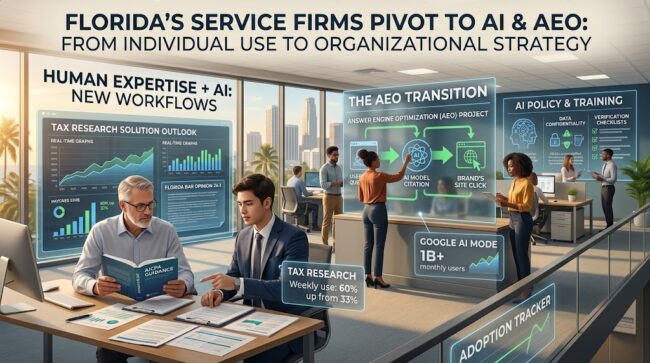
Adoption Tracker: Where Florida Professional Services Stand
| Sector | Individual Use | Formal Policy / Strategy | Regulatory Posture (Florida) | Primary AEO Exposure |
|---|---|---|---|---|
| Law firms | 69–75% | 9% enforced policy | Opinion 24-1; Rule 4-1.1 amended; circuit disclosure orders (Miami-Dade, Broward, Palm Beach) | High — informational legal queries |
| Accounting / tax | 60% weekly research use | 21–22% defined strategy | AICPA guidance; carrier and client-confidentiality risk | High — tax and compliance questions |
| Marketing agencies | 86% of SEO pros use AI | 43% implementing AEO | None specific | Direct — the service itself is changing |
Figures are national survey data unless noted; Florida-specific adoption surveys were not available for this report. Regulatory posture is Florida-specific.
Methodology
This report assembles public survey data from 8am (2026 Legal Industry Report), Clio (2026 Legal Trends), Thomson Reuters (2026 AI in Professional Services), Blue J and CPA.com (2026 AI Tax Research Solution Outlook), Karbon, KPMG, AICPA, GoodFirms, Seer Interactive, Similarweb, Semrush, Ahrefs, Datos, and Bain; regulatory sources including Florida Bar Ethics Opinion 24-1, the Florida Supreme Court’s 2024 rule amendments, and 2026 administrative orders from Florida’s Eleventh, Fifteenth, and Seventeenth Judicial Circuits; and reporting by the Florida Bar, the ABA, the North Carolina Bar Association, and industry publications. Survey figures are national unless otherwise stated; several AEO statistics come from vendors with a commercial interest in the category and are presented as ranges with their sources. No firm named was consulted, and none has a client relationship with the author.
Frequently Asked Questions
Can Florida lawyers use ChatGPT or other AI tools?
Yes. Florida Bar Ethics Opinion 24-1 permits generative AI use, provided the lawyer protects client confidentiality, supervises the output, independently verifies anything filed with a court, and discloses AI use where it affects billing.
Do Florida courts require disclosure of AI use in filings?
Several do. Miami-Dade, Broward, and Palm Beach circuit courts issued administrative orders in 2026 requiring disclosure of generative AI use on the face of filings, with certification that citations were verified. Other circuits have issued similar guidance.
How many accounting firms use AI in 2026?
Adoption varies by definition. Sixty percent of tax professionals use AI research tools weekly (Blue J / CPA.com), 40% of professional-services organizations report generative-AI use (Thomson Reuters), and only about 21–22% have a defined AI strategy.
What is answer engine optimization (AEO)?
AEO is the practice of structuring content and authority signals so that AI systems — Google AI Overviews, AI Mode, ChatGPT, Perplexity, Claude — cite and recommend a business inside the answer itself, rather than relying only on traditional search rankings.
Does AI search reduce website traffic for Florida businesses?
For businesses not cited in AI answers, yes: one study found organic clicks fell 61% on queries where an AI Overview appeared. Businesses that are cited saw clicks rise 35%. The traffic is concentrating, not disappearing.
What is the biggest AI risk for Florida professional-service firms?
Governance. Nearly half of legal respondents have no AI policy, 46% of accounting firms have inadvertently entered confidential client data into public AI tools, and Florida has already seen public reprimands for fabricated AI citations.
Brian’s Take
I spent years watching technology adoption in financial services follow the same arc: individuals adopt, firms lag, regulators catch up, and then the firms that built governance early turn it into a competitive advantage. Florida professional services are at the third step.
What stands out is that Florida’s regulators got there first. Opinion 24-1 predates most state guidance by a year or more, the competence rule was amended before most bars had a committee, and the 2026 circuit court disclosure orders are among the most specific in the country. That is not a burden for Florida firms; it is a template. A firm that can say, in plain language, “here is how we use AI, here is how we verify it, here is the court order we comply with” has a marketing asset that a firm in a state with no guidance cannot manufacture.
The second point is that the two transitions in this report are one transition. Every survey shows the same gap: high individual use, low institutional structure, and almost no measurement of what the AI is doing for the business. The AEO data shows the same gap from the outside: 43% of marketers say they are optimizing for AI answers and 14% are measuring whether it works. A firm that fixes the internal gap — policy, training, verification — produces exactly the kind of documented expertise that fixes the external gap, because answer engines cite authority they can verify. The firms treating AI compliance as a cost center and AEO as a marketing expense are running two projects that should be one.
The third point is a caution about the numbers. Much of the AEO statistical base comes from vendors selling AEO services, and the ranges are wide — 25% to 60% for AI Overview prevalence, 22% to 93% for zero-click rates depending on which surface you measure. I have shown the ranges and the sources. Directionally, the shift is not in doubt. Precisely, nobody has it pinned down yet, and any Florida firm buying an AEO engagement should ask which of these numbers the vendor is using and why.
Sources and Further Reading
- North Carolina Bar Association, “By The Numbers: What Surveys Show About Law Firm AI Adoption,” May 20, 2026 — https://www.ncbar.org/nc-lawyer/2026-05/by-the-numbers-what-surveys-show-about-law-firm-ai-adoption/
- American Bar Association Law Practice Magazine, “AI for Law Firms: What the 8am Legal Industry Report Tells Us About AI Use,” March–April 2026 — https://www.americanbar.org/groups/law_practice/resources/law-practice-magazine/2026/march-april-2026/8am-legal-industry-report/
- The Florida Bar, “New Florida Bar guide helps lawyers incorporate AI responsibly in their work,” February 20, 2025 — https://www.floridabar.org/the-florida-bar-news/new-florida-bar-guide-helps-lawyers-incorporate-ai-responsibly-in-their-work/
- Business Law Section of The Florida Bar, “Before You Prompt: AI, Privilege, and Confidentiality for Florida Lawyers,” July 24, 2026 — https://flabizlaw.org/member-articles/before-you-prompt-ai-privilege-and-confidentiality-for-florida-lawyers/
- Legal AI Governance, “Florida AI Ethics Guidance for Law Firms” (circuit court order tracker), April 2026 — https://legalaigovernance.com/tracker/states/florida/
- Almazan Law, “AI in Florida Courts (2026): Miami Litigation Rules, Ethics & Disclosure,” March 2026 — https://www.almazanlaw.com/blog/2026/february/ai-in-florida-courts-2026-miami-litigation-rules/
- FirmAdapt, “Bar Association Guidance on AI: A 2026 State-by-State Map,” May 26, 2026 — https://firmadapt.com/blog/bar-association-guidance-ai-2026-state-map
- Clearbrief, “Florida Bar AI Ethics Opinion 24-1: Essential Guidelines for Solo and Small Firm Lawyers” — https://clearbrief.com/legal-ai-resources/florida
- CPA.com, “Blue J and CPA.com Survey Finds AI Adoption Among Tax Firms Has Nearly Doubled in One Year,” June 8, 2026 — https://www.cpa.com/news/blue-j-and-cpacom-survey-finds-ai-adoption-among-tax-firms-has-nearly-doubled-one-year
- ACCWire, “Accounting Firms Using AI in 2026: Tools and Examples,” August 2026 — https://www.accwire.com/accounting-firms-ai-2026/
- CurateSuite, “AI in Accounting: 80 Statistics for 2026,” July 3, 2026 — https://curatesuite.com/accounting/articles/ai-accounting-statistics-2026
- AIOpsNav, “AI Adoption in Accounting Firms: 2026 State Report,” May 15, 2026 — https://aiopsnav.ai/ai-accounting-firms
- CPA Trendlines, “Outlook 2026: Agentic AI Reaches the Tipping Point in Tax and Accounting Firms,” 2026 — https://cpatrendlines.com/2026/01/10/outlook-2026-agentic-ai-reaches-the-tipping-point-in-tax-and-accounting-firms/
- Similarweb, “Answer Engine Optimization: The Complete 2026 Guide,” May 20, 2026 — https://aisearch.similarweb.com/blog/answer-engine-optimization/
- GoodFirms, “AI SEO Statistics 2026: 35+ Verified Stats & 9 Research Findings,” August 2026 — https://www.goodfirms.co/resources/seo-statistics-ai-search-rankings-zero-click-trends
- Brenton Way, “AEO Statistics 2026: AI Search & Zero-Click Trends,” August 2, 2026 — https://brentonway.com/blog/aeo-statistics
- QuickSEO, “Google AI Overviews Statistics 2026: 60+ Data Points” (citing Datos Q1 2026), May 1, 2026 — https://quickseo.ai/blog/google-ai-overviews-statistics-2026-60-data-points-every-seo-should-know
- Omnibound, “AI SEO Statistics (2026): 57+ Data Points on Zero-Click Search,” July 28, 2026 — https://www.omnibound.ai/blog/ai-seo-statistics
- Instant Press, “AEO & GEO Statistics for 2026,” July 13, 2026 — https://www.instantpress.co/aeo-statistics
- SEO Inc., “AI And SEO In 2026: Zero-Click Search, AI Overviews & GEO,” June 22, 2026 — https://www.seoinc.com/seo-blog/ai-and-seo-2026/
About the Author