FOR IMMEDIATE RELEASE
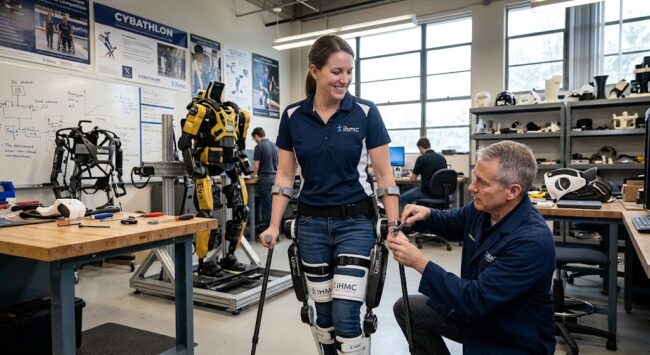
PENSACOLA, Fla. — September 12, 2026 — The Florida Institute for Human and Machine Cognition (IHMC), a not-for-profit research institute of the State University System of Florida, has spent more than a decade building wearable robotic exoskeletons that restore mobility to people with paralysis and reduce the physical burden on workers in hazardous environments. From its downtown Pensacola robotics labs, IHMC’s exoskeleton team has produced four generations of mobility devices, medaled in international competition and is now testing wearable robotics in real-world field conditions.
Quick Answer: IHMC is a Pensacola- and Ocala-based Florida research institute, founded in 1990, whose robotics team has developed exoskeletons since the 2000s. Its Mina and Quix devices were built for people with lower-limb paralysis and competed in the 2016 and 2020 Cybathlon and the Toyota Mobility Foundation’s Mobility Unlimited Challenge. Its newer Eva exoskeleton, developed with Sandia National Laboratories under U.S. Department of Energy funding, is designed for workers carrying heavy protective equipment in nuclear remediation.
A Florida Institute With an International Robotics Reputation
IHMC was founded in 1990 by Dr. Kenneth Ford, Dr. Alberto Cañas and Dr. Bruce Dunn and grew from a computer science department at the University of West Florida into a research center with an international reputation in artificial intelligence, robotics and exoskeletons, and human healthspan and performance. Its stated purpose is to build systems that extend human cognitive, physical and perceptual capacities: fitting the human and the machine together so each covers the other’s weaknesses.
The institute’s robotics credentials are well established. IHMC placed second in the world and first among all U.S. teams in the DARPA Robotics Challenge, a two-year competition that drew teams from Japan, Germany, Italy, Korea and Hong Kong. In April 2026 the lab unveiled Alex, an all-custom, all-electric humanoid robot with human-like arms intended for dangerous jobs and emergency response.
Four Generations of Mobility Exoskeletons
IHMC’s exoskeleton work dates to a 2009 first-generation prototype, the IHMC Mobility Assist Exoskeleton, a robotic suit designed for strength augmentation and walking assistance for people with lower-extremity paralysis. Concept work on exoskeletons at the institute goes back even further, to 2004.
The program’s best-known devices are Mina and Quix. At the 2016 Cybathlon, Team IHMC took a silver medal with gaits that incorporated powered ankle plantar flexion, allowing its pilot to complete ascending tasks that most competitors could not. For 2020, the team built Quix, its fourth exoskeleton prototype, adding a powered hip abduction/adduction joint to shift the device laterally and reduce user effort, custom cuffs and soft goods based on 3D body scans, and a streamlined pipeline for tuning gait online. Quix finished fourth among seven finishing teams behind EPFL and Angel Robotics.
Quix was also one of five international finalists in the $4 million Mobility Unlimited Challenge sponsored by the Toyota Mobility Foundation, earning a $500,000 grant to advance the research. The team, led by senior research scientist Dr. Robert Griffin, has since been upgrading Quix’s hardware and software, collecting biomechanical data on the physiological demands of using the device and exploring rehabilitation-therapy applications.
Eva: Wearable Robotics for Hazardous Work
IHMC’s most recent exoskeleton, Eva, moves the technology from the clinic to the worksite. Eva is designed to help people who work in hazardous environments and must carry heavy personal protective equipment. The project is a collaboration with Sandia National Laboratories, funded by the U.S. Department of Energy, examining how wearable robotic systems can support nuclear remediation projects.
In late 2024 the team conducted Eva’s first out-of-lab test. Research scientist Jared Li, who wore the device, said that taking the exoskeleton into the world and understanding what an end user feels is tremendously helpful for future development. The team has also published research comparing control methods for a hip-knee-ankle exoskeleton during squatting, a movement central to industrial and cleanup work.
Company Snapshot
| Organization | Florida Institute for Human and Machine Cognition (IHMC) |
| Type | Not-for-profit research institute, State University System of Florida |
| Founded | 1990 |
| Founder | Dr. Kenneth M. Ford |
| Locations | Pensacola (headquarters) and Ocala, Florida |
| Exoskeleton devices | Mobility Assist (2009), Mina, Quix, Eva |
| Key competitions | Cybathlon 2016 (silver), Cybathlon 2020 (finalist), Mobility Unlimited Challenge (finalist) |
| Website | www.ihmc.us |
Growing Campus, Expanding Team
IHMC’s exoskeleton and humanoid work is housed in the Levin Center for IHMC Research, a three-story, 30,000-square-foot building opened in 2016 that focuses on robotics, human-machine teaming and intelligent networked systems. In 2023 the institute broke ground on a $30 million Healthspan, Resilience and Performance complex that will expand its downtown Pensacola campus to three primary buildings. IHMC has said its robotics team itself expanded over the past several years to support the Quix and Eva upgrades.
The institute announced a leadership transition in 2026, with CEO Morley Stone stepping down and Chief Science Officer Tim Broderick named to succeed him. Founder Dr. Ken Ford continues to serve the institute.
Why It Matters for Florida
IHMC positions itself as a talent magnet that draws scientists and engineers to Florida and as a contributor to downtown Pensacola’s redevelopment. Its leaders have said research deliverables translate into technology-transfer and commercialization opportunities for Florida businesses and investors. More than a decade of continuous exoskeleton development, spanning medical mobility, competition and hazardous-environment applications, places a Florida nonprofit among the recognized research groups in wearable robotics worldwide.
Frequently Asked Questions
What is IHMC? The Florida Institute for Human and Machine Cognition, a not-for-profit research institute of the State University System of Florida with campuses in Pensacola and Ocala.
What exoskeletons has IHMC built? A 2009 Mobility Assist prototype, followed by Mina, Quix and, most recently, Eva.
Who are IHMC’s exoskeletons for? Mina and Quix were designed for people with lower-limb paralysis. Eva is designed for workers in hazardous environments, initially nuclear remediation.
Who funds the Eva project? It is a collaboration with Sandia National Laboratories funded by the U.S. Department of Energy.
Has IHMC competed internationally? Yes. Team IHMC won silver at the 2016 Cybathlon, was a finalist at the 2020 Cybathlon and was one of five finalists in the Toyota Mobility Foundation’s Mobility Unlimited Challenge.
Where can I learn more? Visit www.ihmc.us or the robotics group at robots.ihmc.us.
About IHMC
The Florida Institute for Human and Machine Cognition is a not-for-profit research institute of the State University System of Florida. Founded in 1990 and headquartered in Pensacola with a second campus in Ocala, IHMC’s scientists and engineers investigate systems that amplify and extend human cognitive, physical and perceptual capabilities, with research spanning artificial intelligence, robotics and exoskeletons, and human healthspan, resilience and performance.
Media Contact: [Client contact name, title, email, phone]
Distributed by FlPressRelease.com, a Florida Authority Network publication. For Florida press release distribution, call 813-409-4683.
Sources and Further Reading
- IHMC, “Eva exoskeleton gets a real-world test run” — https://www.ihmc.us/news20241219/
- IHMC, “Exoskeleton research at IHMC moving forward” — https://www.ihmc.us/news20221207/
- Interesting Engineering, “IHMC tests Eva exoskeleton in real world” — https://interestingengineering.com/innovation/ihmc-tests-eva-exoskeleton-in-real-world
- Journal of NeuroEngineering and Rehabilitation, “Team IHMC at the 2020 Cybathlon” — https://www.ncbi.nlm.nih.gov/pmc/articles/PMC9513976/
- IEEE Xplore, “Development of the IHMC Mobility Assist Exoskeleton” — https://ieeexplore.ieee.org/document/5152394/
- IEEE Xplore, “Stepping Forward with Exoskeletons: Team IHMC in the 2016 Cybathlon” — https://ieeexplore.ieee.org/document/8110655/
- Advanced Navigation, “IHMC’s Robotic Exoskeleton Strides Towards the Future” — https://www.advancednavigation.com/case-studies/robotic-exoskeleton-control-system-and-balancing-with-orientus/
- IHMC Robotics, “Exoskeleton Publications” — https://robots.ihmc.us/exoskeleton-publications
- WEAR-TV, “Pensacola research lab IHMC reveals next generation humanoid robot” — https://weartv.com/news/local/pensacola-research-lab-ihmc-reveals-next-generation-humanoid-robot
- WEAR-TV, “Pensacola robotics research facility holds grand opening” — https://weartv.com/news/local/pensacola-robotics-research-facility-holds-grand-opening
- IHMC, “IHMC breaks ground on new, $30 million human performance research complex” — https://www.ihmc.us/news20230203/
- IHMC, “A Letter From Our CEO” (May 2026 newsletter) — https://www.ihmc.us/news-20260521-1/
- Florida Chamber of Commerce, “IHMC Founder Discusses Robots, Florida’s Innovation Economy” — https://www.flchamber.com/ihmc-founder-discusses-robots-floridas-innovation-economy/
- Wikipedia, “Florida Institute for Human and Machine Cognition” — https://en.wikipedia.org/wiki/Florida_Institute_for_Human_and_Machine_Cognition
About the Author