FOR IMMEDIATE RELEASE
Construction Labor Demand Hits New Highs in South Florida — ABC Florida East Coast Chapter Opens Doors to the Next Wave of Trade Professionals
As the tri-county building boom accelerates, the region’s premier construction educator outlines exactly what it takes to enroll, train, and launch a career in the trades
COCONUT CREEK, FL — July 1, 2026 — South Florida is building faster than it can hire. From the residential towers rising along Biscayne Bay to the warehouses, hospitals, schools, and transit projects spreading west across Miami-Dade, Broward, and Palm Beach counties, the tri-county construction market has entered one of the strongest sustained growth cycles in its history — and the workers needed to deliver that work are in critically short supply.
The ABC Florida East Coast Chapter, the region’s leading construction education provider based in Coconut Creek, is inviting South Floridians to seize the moment. Today the chapter published a clear roadmap for prospective students: what the opportunity looks like, what its programs deliver, and — most importantly for the thousands of residents considering a career change — exactly what it takes to qualify and enroll.
A Labor Market Tilted Decisively in Workers’ Favor
The numbers behind the regional boom tell a consistent story. Population growth continues to pour new residents into South Florida, driving relentless demand for housing. Corporate relocations and expansions are filling commercial pipelines. Aging infrastructure requires replacement, coastal resilience projects are moving from planning to construction, and insurance-driven roofing and hardening work has created an entire sub-economy of its own.
Meanwhile, the supply side of the labor equation is moving in the opposite direction. A generation of baby-boomer tradespeople is retiring faster than younger workers are replacing them, and years of cultural emphasis on four-year degrees left vocational pipelines underdeveloped. The result is a structural gap between the work South Florida needs done and the people qualified to do it.
For job seekers, that gap translates directly into opportunity. Wages across the skilled trades have climbed steadily as contractors compete for talent. Signing incentives, overtime availability, rapid advancement, and employer-paid training — once rarities — are now common features of the regional market. Perhaps most tellingly, trained workers entering the field today can realistically expect to remain in demand for the length of an entire career, given the decades of projected construction activity ahead.
“We hear the same thing from contractors every single week: send us more people,” said a spokesperson for the ABC Florida East Coast Chapter. “There has genuinely never been a better time to enter this industry in South Florida. The jobs are here, the wages are rising, and the training to qualify for it all is available right now, close to home.”
What Enrollment Actually Requires
For many prospective students, the biggest barrier to a construction career is not ability — it is simply not knowing where to begin or what qualifications are expected. The chapter’s answer: less than most people assume.
The organization’s core construction worker training South Florida programs are built to be accessible to motivated beginners. While specific requirements vary by program, applicants to the chapter’s registered apprenticeship tracks can generally expect the following baseline criteria:
- Minimum age. Apprenticeship applicants must typically be at least 18 years old by the time classes begin, as programs involve employment on active jobsites.
- Education. A high school diploma or GED is the standard educational requirement for apprenticeship enrollment. The emphasis is on foundational reading and math ability — measuring, calculating, and following written instructions are daily realities of trade work — not advanced academics.
- Legal work authorization. Because apprentices are employed and paid by sponsoring contractors from the start of their training, applicants must be legally eligible to work in the United States and able to complete standard employment documentation.
- Physical readiness. Construction is active work. Applicants should be capable of the physical demands of their chosen trade, including lifting, climbing, standing for extended periods, and working in South Florida’s outdoor conditions.
- Reliable transportation. Students must be able to travel dependably to both evening classes and daytime jobsite assignments across the tri-county area.
- Employment with a sponsoring contractor. The defining feature of the apprenticeship model is paid, on-the-job training. Applicants either arrive already employed by a participating merit shop contractor or work with the chapter to connect with member companies that are actively hiring apprentices — a process the region’s labor shortage has made faster than ever.
- Commitment. Apprenticeships run multiple years, combining full-time work with structured evening instruction. The chapter looks for applicants prepared to see the program through — because those who do graduate into journeyman-level credentials, years of documented experience, and zero student debt.
Shorter-format offerings, including safety certifications and continuing education courses, carry even fewer prerequisites, making them an ideal first step for those testing the waters before committing to a full apprenticeship.
“People assume there’s some hidden gatekeeping, and there just isn’t,” the spokesperson said. “If you’re eighteen, you have your diploma or GED, you can legally work, and you’re willing to show up and put in the effort, we have a path for you. The trades are one of the last places in the American economy where the door is genuinely open.”
The Trades Driving the Hiring Surge
While demand spans every craft, two trades stand out for the sheer intensity of employer need in the commercial sector: electrical and mechanical.
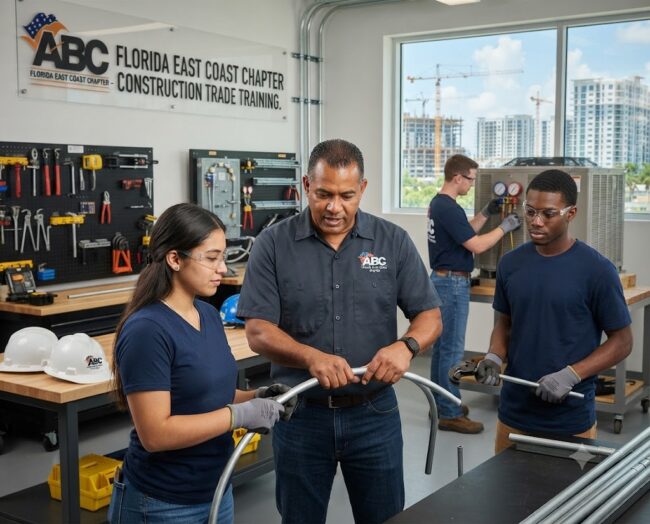
South Florida’s commercial pipeline — data centers, healthcare facilities, high-rise cores, logistics hubs, and large-scale retail — runs on increasingly sophisticated electrical systems, and contractors report acute shortages of qualified installers at every level. The chapter’s electrical training for commercial construction in South Fl apprenticeship prepares students for exactly this work: conduit bending and installation, wiring methods, panel and distribution work, motor controls, code compliance under the National Electrical Code, and the safety practices that high-voltage commercial environments demand. Graduates enter one of the highest-paying and most consistently employed trades in the region, with clear paths toward journeyman status and, for the ambitious, electrical contracting licensure.
Climate control tells a similar story. In a subtropical market where air conditioning is not a luxury but a structural necessity, mechanical trades enjoy year-round, recession-resistant demand. The chapter’s HVAC training for commercial construction in South Fl program trains students in the installation, service, and maintenance of the large-scale systems that keep the region’s offices, hospitals, schools, and industrial facilities running — chillers, rooftop units, ductwork systems, controls, and refrigeration — along with EPA certification preparation and the energy-efficiency knowledge that modern green building standards require.
Both programs pair evening classroom instruction with paid daytime employment, meaning students in these high-demand trades begin earning industry wages from their very first week.
One Campus Network, Every Career Stage
What draws many students to the chapter over piecemeal alternatives is consolidation: a single trusted school for construction work in South Fl where an entire career can be built end to end. A student might start with an OSHA safety card, progress through a four-year craft apprenticeship, add specialty certifications along the way, and later return for supervisory and leadership training as they advance into foreman and superintendent roles.
That continuity matters. Instructors watch students develop over years, employers recruit from a talent pool they helped train, and credentials stack in a deliberate sequence rather than accumulating at random. Every course completed strengthens the value of the ones before it.
The chapter’s standing in the industry reflects that model’s success. Contractors and workforce officials across the tri-county region consistently rank it the top school construction training in South Fl provides, a reputation earned through decades of graduates who arrive on jobsites ready to work safely and productively from day one. As the training affiliate of Associated Builders and Contractors for Florida’s east coast, the chapter maintains direct curriculum input from the employers doing the hiring — a feedback loop few standalone schools can replicate.
How the Application Process Works
The chapter has deliberately streamlined its intake to keep momentum on the applicant’s side. Prospective students begin by reviewing program options online and submitting an application for their trade of interest. Chapter staff then guide qualified applicants through documentation, aptitude assessment where applicable, and — for those not already employed in the industry — introductions to sponsoring contractors with open positions.
Because classes operate on scheduled enrollment cycles, applicants are encouraged to begin the process early. High demand for seats, particularly in the electrical and HVAC programs, means classes routinely fill in advance of their start dates.
Financial concerns should stop no one from applying. The apprenticeship structure inverts the usual economics of education: rather than paying to learn while forgoing income, students earn wages throughout, with tuition frequently supported by sponsoring employers. For career changers supporting families, that difference often makes the decision.
A Regional Imperative, A Personal Opportunity
The stakes of workforce development extend well beyond individual careers. Every project delayed for lack of labor carries real costs for South Florida — housing that arrives later and pricier, infrastructure that lags population growth, storm-resilience work left undone. Training local residents to fill local jobs keeps wages in local communities and gives the region control over its own building capacity.
But for the individual reading this release, the calculus is simpler. South Florida will spend decades building, rebuilding, and hardening itself. The people who learn to do that work — safely, skillfully, and with recognized credentials — will not want for employment, income, or advancement.
The door is open. The requirements are within reach. The training is here.
Career Changers and Veterans: The Industry Wants You
The chapter’s incoming classes increasingly reflect the full breadth of South Florida’s workforce. Alongside recent high school graduates sit former hospitality workers, retail managers, rideshare drivers, and office professionals drawn by the trades’ combination of job security and earning power. Program staff report that career changers in their late twenties, thirties, and beyond routinely become standout students — arriving with work discipline, customer-service instincts, and a clarity of purpose that accelerates their progress.
Military veterans represent another natural fit. The structure, safety discipline, and teamwork of construction map closely onto military experience, and many veterans find that leadership responsibilities follow quickly once they enter the field. The chapter works with veterans and veteran-serving organizations to smooth the transition into apprenticeship, and encourages those leaving service to explore the trades before assuming a desk job is the only path forward.
No prior construction experience is required for entry-level enrollment in either case. The programs are designed to build skill from the ground up; what applicants must bring is reliability, willingness to learn, and readiness to work.
What Graduates Can Expect to Earn
While individual results vary by trade, employer, and effort, the financial arc of a South Florida apprenticeship follows a well-established pattern. Apprentices begin earning immediately at entry-level wages, receive structured raises as they log hours and complete coursework, and typically reach journeyman-level pay upon graduation — compensation that in today’s market rivals or exceeds the starting salaries of many university graduates, achieved without tuition debt and with four years of income already banked.
From there, the ceiling keeps rising. Experienced journeymen in high-demand trades command premium wages in the current market. Those who advance into foreman, superintendent, estimating, or project management roles climb further still, and the entrepreneurially minded can pursue contractor licensure and business ownership. Because the chapter’s credential ladder extends through leadership training, graduates never outgrow the institution that started their careers.
Enroll or Learn More
Program descriptions, schedules, application details, and enrollment requirements for all safety, apprenticeship, and professional development offerings are available at https://abceastflorida.com/. Staff are available during business hours to help applicants identify the right starting point.
About the ABC Florida East Coast Chapter
The ABC Florida East Coast Chapter serves the merit shop construction industry across Miami-Dade, Broward, and Palm Beach counties as the regional affiliate of Associated Builders and Contractors. Its registered apprenticeships, craft training, safety education, and leadership development programs supply the skilled workforce behind South Florida’s growth while advancing open competition and free enterprise across the industry.
Contact Information
ABC Florida East Coast Chapter — Corporate Office
3730 Coconut Creek Pkwy, Suite 200
Coconut Creek, FL 33066
Phone: (954) 951-3911
Website: https://abceastflorida.com/
Hours of Operation: Monday – Friday: 9:00 am – 5:00 pm
About the Author