FOR IMMEDIATE RELEASE
HCI College South Florida’s Leader in Accelerated Healthcare Education, Addressing Critical Workforce Shortages Driven by Demographic Influx
FORT LAUDERDALE and WEST PALM BEACH, Fla. — As the regional medical landscape undergoes a profound structural shift, HCI College has solidified its position as the premier institution for accelerated healthcare training in South Florida. With hospital networks, urgent care franchises, and private clinical practices facing unprecedented staffing challenges, the college’s targeted educational model provides a vital pipeline of licensed, competent medical professionals ready to enter the workforce in a fraction of the time required by traditional four-year universities.
South Florida’s booming population, characterized by a massive influx of retirees and senior citizens, has created a historic surge in the demand for healthcare services. To meet this macroeconomic challenge, HCI College offers optimized pathways to licensure and employment through its strategically located campuses in Fort Lauderdale and West Palm Beach. By eliminating non-specialized general studies electives, the institution ensures that students focus entirely on the core clinical competencies, medical vocabulary, and practical skills needed at the patient’s bedside.
The Macroeconomic Catalyst: Why Florida Healthcare Jobs are Facing Historic Demand
To fully understand the immense value of an accelerated diploma or degree from HCI College, one must analyze the unique demographic forces shaping the Sunshine State. Healthcare in Florida is not merely a static public utility; it is a multi-billion-dollar economic engine expanding at a record pace. Unlike traditional corporate sectors that experience cyclical layoffs, downsizing, and automation risks, the medical field enjoys robust economic insulation.
The primary driver of this sustained expansion is the well-documented shift in regional demographics. Florida has long been the nation’s premier destination for retirees, leading to a population distribution heavily weighted toward individuals over the age of 65. As the massive baby-boomer generation continues to migrate to the state, the strain on the regional medical infrastructure increases exponentially. Older adults naturally present a higher prevalence of complex, chronic conditions—including cardiovascular diseases, metabolic syndromes, multi-system orthopedic issues, and age-related cognitive declines—that require ongoing, sophisticated management. Consequently, local hospital conglomerates and private healthcare providers are forced to scale up their human capital continuously to prevent localized capacity crises.
Beyond the retirement wave, South Florida is experiencing consistent general population growth. Individuals and young families migrate to the region daily, drawn by economic opportunities and lifestyle factors. This continuous influx expands the baseline client pool for every facet of medicine, from pediatric practices and maternal-newborn units to emergency trauma networks and ambulatory surgical centers. Major healthcare networks are investing heavily in constructing state-of-the-art facilities across Broward and Palm Beach counties to keep pace with this demand. However, a modern medical facility with advanced diagnostic telemetry is non-functional without a steady pipeline of certified professionals. Because medical institutions must maintain strict, legally mandated staffing ratios to guarantee patient safety, licensed practical nurses, registered nurses, and medical assistants find themselves in an environment with near-zero unemployment and an absolute surplus of open positions.
The Fast-Track Advantage: Earning a License in Less Time Than a Four-Year University
For many aspiring medical professionals, the traditional four-year university model presents significant barriers to entry. Spending forty-eight months completing broad general education requirements delays direct clinical exposure and increases the overall opportunity cost of education. Specialized career education represents a modern paradigm shift, optimizing the learning curve so that students spend their time exclusively on the practical mechanics and theoretical frameworks utilized in real-world clinical settings.
+----------------------------------------------------------------------------+
|                        ACCCELERATED PATHWAY COMPARISON                     |
+----------------------------------------------------------------------------+
|  Traditional University Degree:   [ 4 Years of General Studies & Theory ]  |
+----------------------------------------------------------------------------+
|  HCI College Programs:           [ 10 to 24 Months of Direct Clinical Focus ]|
+----------------------------------------------------------------------------+
By prioritizing technical accuracy, rigorous laboratory simulation, and immediate clinical placement, career colleges prepare students for state board exams ahead of schedule. Graduating earlier allows newly licensed professionals to enter the workforce sooner, collect sign-on bonuses, secure full-time healthcare benefits, and begin climbing the institutional seniority ladder well ahead of peers enrolled in traditional academic tracks.
High-Impact Programmatic Offerings at HCI College
HCI College has carefully engineered its curriculum to align directly with the primary licensing demands of the Florida medical sector. The institution offers specialized paths that balance structural academic rigor with career velocity.
Associate of Science in Nursing (ASN) Degree
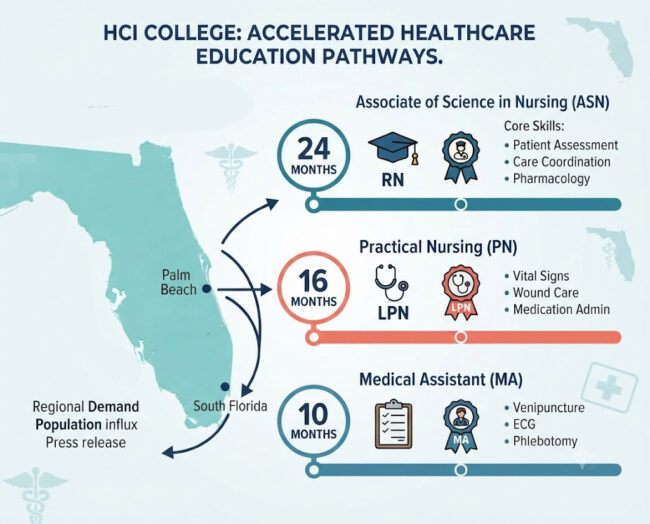
For those aiming to secure maximum clinical autonomy and a versatile career trajectory, the Associate of Science in Nursing (ASN) program provides a comprehensive path to becoming a Registered Nurse (RN) in approximately 24 months. RNs take on high-level responsibilities, including physical and psychological patient assessments, diagnostic data analysis, complex pharmacological administration, and the coordination of multidisciplinary care teams.
HCI College’s ASN curriculum guides students systematically through high-acuity medical-surgical nursing, maternal-infant care, pediatrics, and psychiatric interventions. To ensure incoming students possess the rigorous scientific foundation required to excel in this demanding program, enrolling in foundational Pre RN nursing classes in Fort Lauderdale is highly encouraged. These preparatory tracks ensure mastery over human anatomy, physiology, and microbiology, enabling students to navigate complex advanced medical concepts seamlessly.
Practical Nursing Diploma (LPN)
For individuals seeking the fastest direct entry point into professional bedside nursing, the Practical Nursing diploma program serves as an exceptional vocational vehicle. Licensed Practical Nurses (LPNs) operate as an indispensable core of direct care, measuring vital signs, collecting lab specimens, executing complex wound care protocols, and monitoring patient nutritional intake under the direct supervision of registered nurses and physicians.
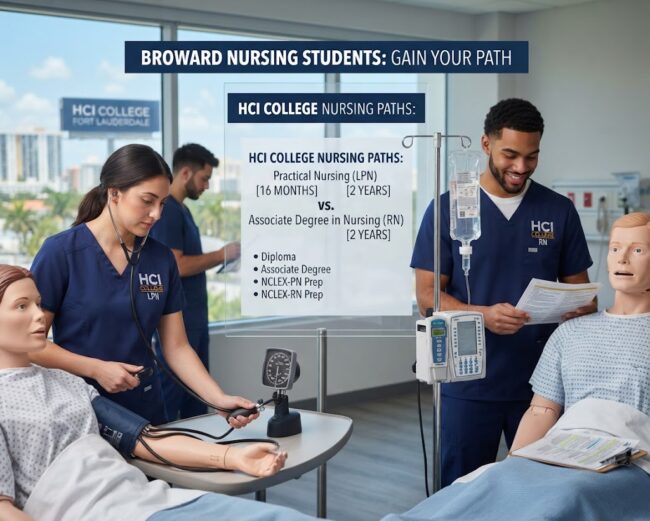
Residents of Broward County can leverage top-tier Fort Lauderdale LPN training to earn their diploma in roughly 16 months. The LPN curriculum at HCI College is an intensive, fast-paced educational experience where students enrolled in a Fort Lauderdale LPN training course apply pharmacological calculations and safety concepts directly within simulation labs. Attending a premier school for LPN in Fort Lauderdale ensures that graduates are fully equipped to challenge the NCLEX-PN exam. For students comparing regional educational providers, HCI College stands out among LPN training schools in South Fl by structuring its Fort Lauderdale nursing training classes to easily accommodate non-traditional student schedules without sacrificing clinical depth.
Medical Assistant Training Certificate
For those who prefer a multifaceted healthcare role that combines clinical execution with front-office administration, a career in medical assisting is ideal. Medical assistants operate as the organizational glue inside multi-provider private practices, urgent care clinics, and specialized diagnostic centers, pivoting between patient care and clerical coordination.
The Medical Assistant training program in Fort Lauderdale at HCI College can be completed in just 10 months. The comprehensive curriculum ensures complete proficiency in administrative duties—such as navigating electronic health records (EHR), medical billing, and insurance verification—alongside hands-on clinical training in venipuncture (phlebotomy), electrocardiograms (ECGs), and minor in-office surgical assistance.
Seamless Statewide Mobility for Florida-Licensed Professionals
Earning a healthcare credential through an approved Florida institution yields significant long-term geographic benefits. Because the severe shortage of medical talent spans the entire state, holding a valid license issued by the Florida Board of Nursing or the Department of Health provides total intra-state mobility.
Once you complete your program at HCI College and pass your professional licensure boards, your credentials allow you to practice anywhere from the panhandle down to the keys. Licensed professionals can seamlessly relocate their careers from the coastal corridors of South Florida to rapid-growth markets in Central Florida, the Gulf Coast, or North Florida without navigating complex out-of-state endorsement processes or retaking expensive examinations. Large healthcare networks across the state actively scout Florida-licensed graduates, frequently offering immediate job placement, competitive compensation, and corporate relocation assistance to secure top talent.
Immersive Clinical Rotations: Connecting Classrooms to Careers
A comprehensive medical education requires bridging the gap between textbook concepts and live patient interactions. HCI College achieves this through a robust, structured clinical rotation framework integrated directly into its nursing tracks. The college maintains strong institutional partnerships with leading South Florida hospitals, skilled nursing facilities, and community outpatient health centers.
During these clinical rotations, students practice under the direct supervision of experienced clinical instructors and seasoned preceptors. This immersive environment requires students to think critically under pressure, prioritize patient needs, monitor real-time physiological changes, and collaborate effectively with multidisciplinary medical teams.
Furthermore, these rotations serve as an extended, real-world job interview. Unit managers and nursing directors use these clinical periods to scout prospective talent. By displaying technical precision, unyielding professionalism, and deep empathy, HCI College students routinely secure concrete job offers weeks before their formal graduation ceremony, ensuring a seamless transition directly into the workforce.
Strategic South Florida Campus Locations
To maximize accessibility for students balancing family commitments and employment, HCI College operates two state-of-the-art campus locations across South Florida. Both facilities feature high-fidelity simulation labs, advanced computer centers, comprehensive medical libraries, and collaborative study spaces designed to replicate modern clinical environments.
For residents in Broward County, Miami-Dade County, or neighboring southern coastal areas, the local Fort Lauderdale campus serves as a central educational hub:
HCI College – Fort Lauderdale Campus
- Phone Number: (954) 626-0255
- Physical Address: 1201 W. Cypress Creek Rd., Suite 101, Fort Lauderdale, FL 33309
For individuals located across Palm Beach County, Martin County, or northern regional corridors, the West Palm Beach campus offers an identical high-quality learning experience:
HCI College – West Palm Beach Campus
- Phone Number: (561) 586-0121
- Physical Address: 1764 North Congress Ave., West Palm Beach, FL 33409
- Location Marker: (Corner of Congress Ave. and Westgate Ave.)
Comprehensive Student Support and Financial Planning Systems
HCI College is dedicated to removing institutional barriers and cultivating student success from initial enrollment through long-term career placement. The college provides a comprehensive support network tailored to the needs of non-traditional and career-shifting students.
- Financial Aid Guidance: The dedicated financial aid department helps students identify and secure vital educational funding. For those who qualify, options include Federal Pell Grants, Federal Direct Subsidized and Unsubsidized Loans, Parent PLUS Loans, private scholarships, veteran educational benefits (GI Bill), and flexible internal institutional payment structures.
- Academic Tutoring Programs: Free peer tutoring networks and structured faculty review sessions are available to help students master challenging concepts in pharmacology, dosage calculations, and pathophysiology.
- Career Services Infrastructure: The Career Services department provides lifelong assistance, executing resume-building workshops, organizing mock interview panels, hosting exclusive on-campus networking events, and providing direct job placement assistance across Florida’s premier healthcare networks.
About HCI College
HCI College is an accredited institutional leader dedicated to providing high-quality, career-focused healthcare education throughout South Florida. Through its diploma and associate degree programs, the college combines interactive distance learning with rigorous on-campus laboratory training and real-world clinical rotations. Staffed by an experienced faculty of active practitioners and licensed educators, HCI College remains committed to addressing critical regional workforce deficits while empowering students to achieve personal stability and professional fulfillment in the medical sector.
Media Contact:
Admissions & Public Relations Bureau
HCI College – Fort Lauderdale & West Palm Beach
info@hci.edu
About the Author