June 3, 2026
Quick answer: Becoming a nurse in South Florida comes down to four moves—choose a credential (such as Practical Nursing or Registered Nursing), enroll in an accredited program, finish your classroom and clinical training, and pass the NCLEX licensing exam. Timelines range from about 16 months for a Practical Nursing diploma to two or more years for a degree. Accredited schools like HCI College, with campuses in West Palm Beach and Fort Lauderdale, pair hands-on training with financial aid and career placement support to help you finish and get hired.
If you’re standing at the starting line and weighing whether nursing is your move, the questions below are the ones future students raise most—grouped by where you likely are in your thinking, with straight answers to each.
Why So Many South Floridians Are Turning to Nursing
It’s worth understanding the backdrop before diving into specifics. South Florida sits on top of one of the busiest healthcare economies in the nation. Stretching from Palm Beach down through Broward and Miami-Dade, the region pairs a large, aging population with a sprawling system of hospitals, rehabilitation centers, skilled nursing facilities, and outpatient clinics. Layer on a stubborn, long-running shortage of nurses, and the result is steady demand that employers are eager to fill.
That demand is exactly why nursing has become a go-to career for South Florida residents looking for stability, upward mobility, and work that means something. The questions that follow exist to help you turn that opportunity into an actual plan.
Deciding If Nursing Is Right for You
Is nursing really a smart career bet in South Florida?
By most measures, yes. Few fields combine this level of job security with this much room to grow. Nurses are needed across nearly every care setting in the region, and the shortage shows no sign of closing soon. Beyond the numbers, nursing offers something harder to quantify—daily variety, the chance to help people through vulnerable moments, and a career ladder you can keep climbing for decades. If you want work that’s both in demand and personally meaningful, nursing earns its reputation.
Do I have to be a “science person” to make it?
This worry stops more people than it should. You don’t need to arrive as a chemistry whiz or biology star. Nursing programs teach the science you need—anatomy, physiology, pharmacology—from the ground up, and they’re built for students entering healthcare for the first time. What matters far more than a science background is the willingness to study consistently and the discipline to keep up with a fast-moving curriculum. If you’re motivated and organized, the science becomes learnable.
What roles can I realistically aim for?
Nursing isn’t one job; it’s a series of credentials that build on one another. At the entry level, a Certified Nursing Assistant (CNA) provides basic support and requires the least training—useful for testing whether the field fits. A Licensed Practical Nurse (LPN) delivers hands-on bedside care after a diploma program and the NCLEX-PN. A Registered Nurse (RN) handles a broader scope, supervises others, and often specializes, typically after earning a degree and passing the NCLEX-RN. Browsing nearby West Palm Nursing training classes at a single campus is a practical way to see how these levels stack before you choose one.
Choosing Your Path
Should I aim for LPN or RN first?
This is the fork most newcomers wrestle with. Think of it as a question of speed versus scope. The LPN route gets you licensed and working faster, with a shorter, more affordable program—ideal if you want to start earning sooner or aren’t ready to commit years up front. The RN route takes longer and demands more (often prerequisites and an entrance exam) but unlocks a wider scope of practice, more independence, and stronger long-term pay.
Here’s the reassuring part: it isn’t a permanent choice. Plenty of nurses begin as LPNs, gain experience while earning a paycheck, and later bridge into an RN role. Starting with practical nursing doesn’t close the door on becoming an RN—it can be the on-ramp.
How quickly can I actually be working as a nurse?
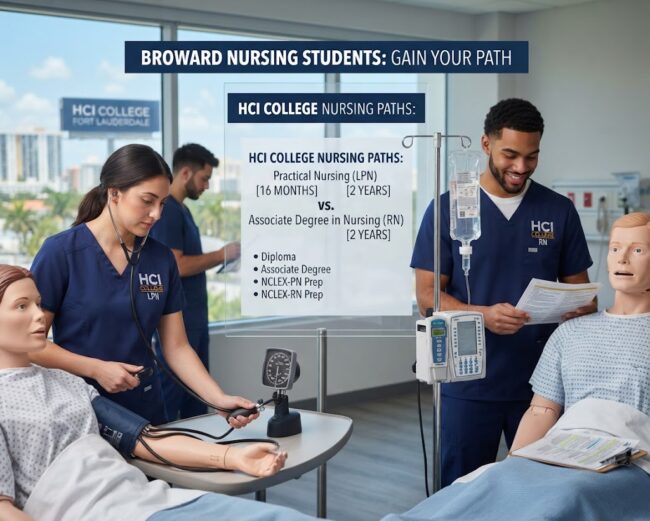
Faster than many people expect, depending on the credential. A CNA course can wrap in weeks. A Practical Nursing program is dramatically shorter than a degree—HCI College’s runs 16 months and leads to NCLEX-PN eligibility. An associate degree for RNs typically takes about two years, and a bachelor’s about four. For career-changers who want momentum, the LPN path is appealing precisely because you can go from no background to licensed nurse in well under two years.
Can I become a nurse without a four-year degree?
Absolutely. Practical Nursing is a diploma-level credential, so you can become a licensed LPN without a bachelor’s degree—you’ll just need a high school diploma or GED to enroll and a passing NCLEX-PN score to be licensed. Becoming an RN does require at least an associate degree, but even there you have options: start in a degree program directly, or begin as an LPN and ladder up. The “right” answer depends on your budget, timeline, and how soon you want to be working.
Getting Admitted
What will a nursing school expect from me?
Requirements vary by program, but most South Florida schools look for a familiar set: a high school diploma or GED, a completed application, valid photo identification, immunization records and a physical, and a background check plus drug screen before clinical rotations begin. Because instruction and the licensing exam are in English, comfort learning in English is essential, and competitive RN degree tracks may add prerequisite courses or an entrance exam.
A practical tip: start the health and background items first, since they take the longest and cause the most delays. When you’re ready to pursue West Palm LPN training, you’ll generally complete an application, sit down with an admissions advisor, submit your documents, and sort out financial aid if needed.
Will I have to pass a test just to get in?
Not necessarily. Many diploma-level Practical Nursing programs skip a standardized entrance exam, which is part of why the LPN path is so approachable. Competitive RN degree programs more often require one—commonly the TEAS—alongside completed prerequisites. Since this varies school to school, confirm the specific expectations of any program before assuming you do or don’t need to test.
What does the NCLEX have to do with picking a school?
Everything. The NCLEX is the national licensing exam—NCLEX-PN for practical nurses, NCLEX-RN for registered nurses—and you can’t practice without passing it. That’s why a school’s accreditation matters so much: in Florida, the Board of Nursing decides whether a program’s graduates are even eligible to sit for the exam, and only approved, accredited programs qualify.
When the college rolled out its West Palm Beach LPN training course, it designed the curriculum around the clinical skills and exam readiness graduates need to pass the NCLEX-PN and move straight into work. The lesson for you: before enrolling anywhere, confirm the program is accredited and that its graduates are NCLEX-eligible. Skipping that check is the costliest mistake an applicant can make.
Money, Time, and Real-Life Logistics
Can I actually afford nursing school?
For most students, the answer is yes—with planning. Tuition varies by credential and school, so request a net-price estimate and ask precisely what’s included rather than reacting to a sticker number. Accredited schools offer several routes to manage cost; HCI College, for example, points to financial aid for those who qualify, plus scholarships, payment options, and career placement assistance for graduates.
To prepare, file the FAFSA if you’ll use federal aid, ask about institutional scholarships, and look into employer tuition help or veteran benefits where they apply. Don’t overlook inclusions, either—HCI’s Practical Nursing program supplies required materials and a uniform set at no extra cost, which quietly reduces the hidden expenses students tend to forget.
Is it realistic to keep working while I study?
Many students do, but honesty about the workload is essential. Nursing programs combine classroom time, labs, and clinical rotations, often on a structured schedule, so they demand real hours. The students who manage to keep a job are usually the ones who plan ahead: they talk to their employer about scheduling before enrolling, line up childcare or family support, and build a study routine early rather than scrambling once classes intensify. Programs with flexible admissions support make this balancing act more doable.
What trips people up most often when starting out?
A handful of avoidable missteps surface again and again. The biggest is enrolling in an unaccredited program, which can derail both financial aid and NCLEX eligibility. Close behind is procrastinating on health and background clearances—the slowest part of the process. Others include choosing the wrong credential for their goals (so they prepare for the wrong requirements), underestimating how much the schedule will demand, and assuming they can’t afford it without ever asking about aid. Sidestep these, and your path gets noticeably smoother.
Where and How to Begin
Where can I get trained for nursing in South Florida?
Look for an accredited school that offers hands-on training, solid NCLEX preparation, and support services that help you cross the finish line. HCI College is one well-known choice, with two campuses across the region:
West Palm Beach campus 1764 North Congress Avenue West Palm Beach, FL 33409 Phone: (561) 586-0121
Fort Lauderdale campus 1201 W. Cypress Creek Rd., Suite 101 Fort Lauderdale, FL 33309 Phone: (954) 626-0255
HCI College is accredited by the Accrediting Commission of Career Schools and Colleges (ACCSC) and licensed by the Florida Commission for Independent Education, and its Practical Nursing program prepares graduates for NCLEX-PN eligibility. Choosing structured LPN nurse training in West Palm Beach gives you a credential you can put to work quickly while leaving room to advance toward an RN role down the line.
What if I’m not totally sure nursing is for me?
That’s a fair place to be, and you have options that keep you in healthcare without committing to a full nursing program right away. Roles like medical assisting blend clinical and administrative work and rank among the most accessible entry points into the field. Some people start there to confirm patient care suits them before pursuing nursing. Comparing medical assistant training in West Palm against nursing programs lets you weigh timelines, costs, and daily responsibilities side by side—helpful if you’re still narrowing down exactly where you want to land.
Am I too old to start a nursing career?
Almost certainly not. Nursing is one of the most welcoming fields for career-changers and later starters, and South Florida programs routinely enroll students in their thirties, forties, and beyond. Life experience often works in your favor—maturity, communication skills, and a clear sense of purpose are genuine assets in patient care. What counts is your ability to commit to the program and meet its requirements, not the year on your birth certificate. If anything, an established applicant who knows exactly why they’re pursuing nursing tends to be among the most determined students in the room.
What does a typical day look like once I’m working?
It varies dramatically by setting, which is part of nursing’s appeal. An LPN in a long-term care facility might focus on medication rounds, monitoring residents, wound care, and charting, building ongoing relationships with the people they serve. A nurse in a busy clinic juggles a rotating cast of patients and faster turnover. Hospital floors bring higher acuity and teamwork with physicians and specialists. Because the work spans so many environments, you can gravitate toward the pace and patient population that fit your temperament—steady and relationship-driven, or fast and high-energy.
Can I specialize or keep advancing later?
Yes, and that flexibility is one of nursing’s biggest draws. Once you’re licensed and working, doors open in many directions: you can pursue certifications, move into areas like pediatrics, geriatrics, surgery, or critical care, step into supervisory roles, or continue your education to climb from LPN to RN and beyond. Nursing rewards lifelong learning, so the credential you earn at the start is a foundation, not a ceiling. Many people enter through the most accessible door available and steadily build the exact career they want from there.
Do I need to live near a campus to enroll?
Not necessarily, though proximity helps with clinical rotations and in-person labs. South Florida’s two HCI campuses sit in West Palm Beach and Fort Lauderdale, putting accredited training within reach of much of the region’s population. If you’re commuting, factor travel time into your schedule alongside class and study hours, and ask the admissions team where clinical placements typically occur so you can plan logistics in advance. For many students, a manageable commute is a worthwhile trade for an accredited program with strong NCLEX preparation and placement support.
What’s the very first thing I should do?
Talk to an admissions advisor. It costs nothing and instantly turns a vague intention into a concrete plan. You can usually connect in person, by phone, or during a campus visit, and a good advisor will walk you through program length, schedule, total cost, aid options, and clinical placement. From there, gather your documents, kick off your health and background clearances early, and lock in a start date. With focused effort, the stretch from first inquiry to enrolled student is often just a few weeks.
The Bottom Line
Breaking into nursing in South Florida is far more attainable than the long list of questions might suggest. Pick your credential, enroll somewhere accredited, complete your training, and pass the NCLEX—every step is reachable with a bit of early preparation. The LPN path offers a fast, affordable start; the RN path offers the widest long-term horizon; and both keep you in one of the region’s most reliably in-demand careers.
The smartest next move is simply to ask your remaining questions out loud, with an advisor who can tailor the answers to your life. Whether you begin by researching West Palm LPN training, comparing pathways, or calling a campus directly, that first conversation is what sets everything else in motion.
References and Resources
1. HCI College — South Florida Campuses
- West Palm Beach campus — 1764 North Congress Avenue, West Palm Beach, FL 33409 | (561) 586-0121 | https://www.hci.edu/location/west-palm-beach
- Fort Lauderdale campus — 1201 W. Cypress Creek Rd., Suite 101, Fort Lauderdale, FL 33309 | (954) 626-0255 | https://www.hci.edu/location/fort-lauderdale
- Practical Nursing program — https://www.hci.edu/programs/practical-nursing
- Medical Assisting program — https://www.hci.edu/programs/medical-assisting
2. Florida Board of Nursing
The state authority that approves nursing programs and determines NCLEX eligibility and licensure in Florida.
- https://floridasnursing.gov
3. NCLEX & NCSBN (National Council of State Boards of Nursing)
Official information on the NCLEX-PN and NCLEX-RN licensing exams, including format, scheduling, and preparation.
- https://www.ncsbn.org/nclex.htm
4. U.S. Bureau of Labor Statistics — Nursing Career Outlook
Current data on job outlook, typical duties, and pay for licensed practical nurses and registered nurses.
- LPN/LVN: https://www.bls.gov/ooh/healthcare/licensed-practical-and-licensed-vocational-nurses.htm
- Registered Nurses: https://www.bls.gov/ooh/healthcare/registered-nurses.htm
About the Author